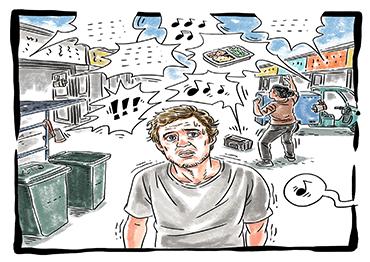
It was shortly after dusk as I strolled along the riverbank, heading home after a busy working Saturday. The heat of the day was slowly easing, and the riverside park provided an oasis of calm, away from traffic and the bustle of people. The walk was almost meditative. Suddenly, the tranquillity was abruptly interrupted by an electrical screech. Within moments, the air filled with the semi-tuned vocals of an enthusiastic lone singer, whose energy levels obscured his older years. From his loudspeaker, vivid Cantopop beats filled the air, and my peaceful trance was shattered. Welcome to the land of the loudspeaker.
In China, there’s always a soundtrack, and it is often delivered through a megaphone or speaker. There are recorded announcements calling on residents to sort their rubbish properly, exercise music for covens of retired ladies to dance to, the jingles and arrival notices of delivery drivers, school loudspeakers calling students to lunch, endlessly repeated warnings to pay attention to slippery surfaces, blaring advertisements beckoning passers-by to buy from their local store, tourist guides wielding megaphones to lead crowds who stand only meters away, and personal speakers sharing social-media messages with everyone in earshot. In cities, these noises tend to blend in with the natural ruckus that is created when tens of millions of people share a space. However, the loudspeakers of China are not limited to the urban environment, they are ubiquitous and feature even in villages and rural life.
I remember one particular instance while walking through a rainforest park near Sanya. I arrived at the top of a staircase, having successfully traversed numerous natural obstacles without harm. At the top, someone had tied a megaphone to a post, delivering a constant stream of pre-recorded “mind the stairs” warnings at a piercing decibel level in Chinese, English and Russian. Clearly, a great deal of thought and effort had gone into ensuring that the park was safe for all potential visitors. Sadly, less thought had gone into whether those visitors might prefer serenity over paternalistic security. On another almost surreal occasion, I was hiking a mountain with a friend when we found ourselves completely alone atop a peak, staring out at some of the most phenomenal scenery on the planet. However, adjacent to the path stood a solitary loudspeaker atop a post, playing a constant orchestral rendition of “Auld Lang Syne.” We were, and remain, rather baffled as to for whom the speaker was intended. We were the only ones around for quite some distance. However, my hiking partner was Scottish, so he did rather wonder if it was a tailor-made welcome for his arrival.
The ubiquitous nature of loudspeakers in China is often a cause of confusion, bemusement, and even complaint for foreign residents. However, a deeper understanding and appreciation of Chinese culture can help shed light upon this dimension of Chinese life. China values the community to an extent that may be unusual in other countries. Public sounds are not an intrusion upon the individual; they are a sign of shared life. Communication is communal. From village announcements to revolutionary radio, collective sound has a long tradition in China of unifying communities and bringing people together. Today’s loudspeakers are direct descendants of that tradition – tools of connection and cohesion. There is a practical dimension to the volume of China, especially within dense and busy urban environments, where volume can equate to efficiency. International visitors to China could be wise to understand the concept of renao – meaning lively and joyful hubbub. This idea has no exact English equivalent or translation. Indeed, it expresses something many foreigners misunderstand. What to Western ears is often considered noise, to a Chinese sensibility it is just life happening.
The noise of China reflects deeper truths about community, communication and confidence. In much of Europe, making loud noises in public is considered shameful, especially on public transport. In English there is even a famous phrase that “silence is golden.” China is different, and after living here for many years I realize that the loudspeakers no longer bother me. They remind me that I am part of something bigger: a society that values shared experience, community cohesion and collective responsibility. Perhaps silence is not golden after all. Perhaps it is overrated. So instead of fighting the daily announcements about mosquito control, square-dancing music and the corner shop’s invitation to buy cheap oranges, let’s embrace our neighbors, embrace our community, and make some noise together!
 Old Version