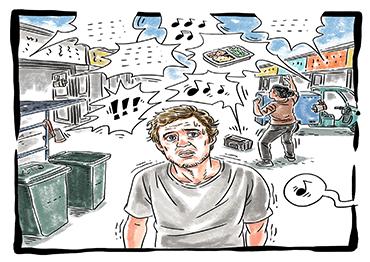
orning traffic in Beijing can feel like total chaos. I used to commute over 10 kilometers by electric scooter every day. I made short work of it though, blasting heavy metal and weaving between more risk-averse drivers. I thought I had mastered the rhythm of rush hour, trying to race the takeout guys as they whizzed off breakfast steamed buns and cups of soy milk.
But Beijing has a way of bringing you back down to earth. Or in this case, back down to the asphalt.
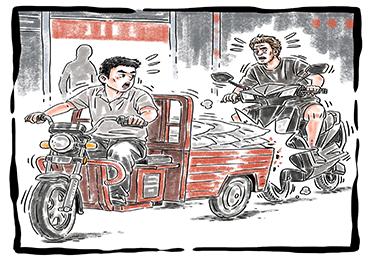
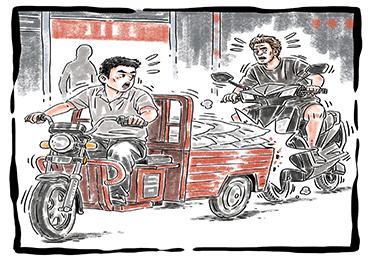
One warm autumn morning, idling at a red light, I cranked my wrist when the green light appeared. I made it maybe 10 meters, before I suddenly stopped making it. A tricycle-trailer reversed into the bike lane and both my scooter and the legs it was carrying plowed into it.
The next thing I knew I was lying in the road giving the panicked tricyclist and anyone else in earshot an impromptu lesson in English profanity.
The tricyclist, a young man from Henan Province who was hauling bags of cement to a construction site, grabbed me under both armpits and yanked me to my feet. Seconds later, he yanked me to my feet again as I’d returned to the road. Eventually, my scooter and I were successfully hauled to the sidewalk. I surveyed the damage. My scooter – cracked. My legs – rapidly swelling and indented with the outline of the tricycle’s trailer.
This incident was met with the customary mix of complete indifference and excessive interest. While most commuters passed by indifferently, an elderly man in pajamas ambled over, declaring it the tricyclist’s fault.
That was a relief. I might be cynical, but my first thought was making sure that I won the argument over responsibility. First, I insisted on getting the tricyclist’s WeChat, as I was paranoid he might just drive off. His profile picture was a little girl, maybe 5 years old.
Next came our phone calls for help – I to my wife, for translation and cultural navigation, the driver to his colleague, to ensure the cement wasn’t delayed.
Soon our supporters showed up. My wife went to chat with the tricyclist, who immediately admitted complete responsibility and agreed to pay for everything. Given this, involving the authorities was deemed unnecessary. This didn’t go down well with tricyclist No. 2.
“Call the cops,” he said. “They’ll side with you. He’s a foreigner.” As the tricyclist waved away the suggestion, my wife pounced on it. “Sure, let’s call them! There’s a camera there and a camera there. Let’s see what kind of deal we can make with them here!”
Chastened, he decided that the cement really should be getting to its destination about now, and left.
With matters of responsibility settled, I limped into the hospital – the crash had conveniently occurred directly outside it. The X-ray showed no fracture and the doctor recommended nothing more than an anti-inflammatory cream. Now a price tag had been put on the damaged human, it was the bike’s turn. Cosmetic repairs only.
The end was rather anticlimactic. The driver forked over about 1,000 yuan (US$142) for the X-ray, the repairs and a token compensation. With a final “very sorry,” the matter was completed. We’d gone through the agreed-upon script and everyone had played their role.
Of course, it wasn’t really the end. For two days, I couldn’t walk. For months, a sharp pain flared up every time I bent my knee too far, which faded to a dull ache, the impact’s stubborn ghost. The scar it left isn’t dramatic, a red blob and a shallow dent.
Another thing that stuck with me was his WeChat photo – his little daughter. There was never any doubt about the “right” and “wrong” from a legal perspective, but I still felt uneasy. The money he handed over could have gone to her, for school, a new dress, a special treat. Instead, it went to my X-ray and a cracked scooter fender. A moment’s inattention had cost him a few days’ wages.
I thought I’d learned to master Beijing’s rush hour. But a more profound lesson was delivered by an honest, if inattentive, tricyclist. It’s not easy to admit fault and do the right thing. The scar just isn’t a reminder of the crash; it's a reminder of the weight of his apology, and the discomfort of being on the receiving end of a responsibility paid in full.
 Old Version