Old Version
Economy

Green for Miles

Government subsidies and lower operating costs are driving rapid adoption of new energy heavy-duty trucks in China, though limited range, slow charging and high up-front costs are still bumps in the road

By Chen Huaishan Updated Dec.1

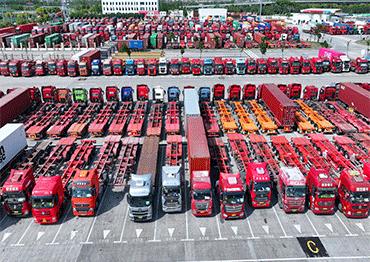
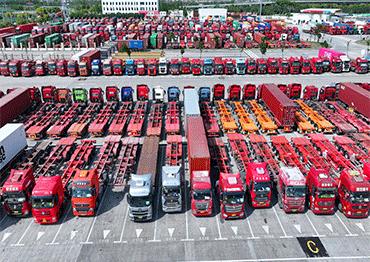
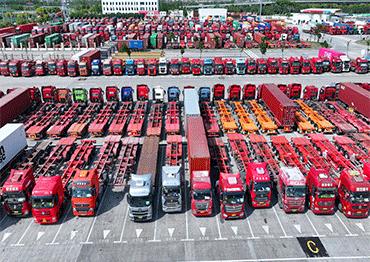
Trucks are parked in the logistics area of the Shanghai Lingang Free Trade Zone, April 20, 2025 (Photo by VCG)

In the past few years, China’s new energy vehicle (NEV) market has experienced exponential growth. NEVs, which include electric vehicles, plug-in hybrid vehicles and a negligible share of fuel cell vehicles (mainly hydrogen), accounted for about 41 percent of new passenger vehicle sales in 2024, cementing China’s position as the world leader in NEV adoption. In the first nine months of 2025, the figure further rose to 52 percent, according to China Automobile Dealers Association.  

By comparison, the shift has been far slower in the freight vehicle sector. Although sales of new energy trucks have picked up, their transition still lags well behind that of passenger cars. In 2023, the penetration rate of new energy commercial vehicles (the ratio of the unit of new energy commercial vehicles to the total unit of commercial vehicles sold) reached about 11 percent, with only 6 percent for trucks. In the first eight months of 2025, the penetration rate rose to 25 percent, with 23 percent for trucks, much lower than the 45.5 percent for all new energy autos, according to China Association of Automobile Manufactures.  

The central government has long considered energy transition of freight vehicle as an environmental and economic necessity, especially as freight vehicles are a major source of pollutants in China. According to a report released by the Ministry of Ecology and Environment in March, freight trucks accounted for 83.7 percent of nitrogen oxide emissions from all road vehicles in 2023, with heavy-duty models alone accounting for 75.7 percent. 

Roadside Assistance 
Reducing emissions from freight vehicles is a major component of the country’s efforts to deliver its dual carbon pledge: to peak emissions by 2030 and achieve neutrality by 2060. Given China’s status as the world’s largest truck market, a successful transition to new energy can consolidate China’s position as the world’s leading battery and electric vehicle technology leader.  

This is why the government launched a new program in 2024 to boost the development of new energy trucks, offering cash subsidies to owners willing to replace their China III and IV emissions-rated diesel trucks – standards phased in from 2014-2015 and December 2022 respectively – with cleaner models. Purchase tax exemptions for new energy trucks were extended until 2027.  

In May 2024, the State Council, China’s cabinet, released the 2024- 2025 Energy Conservation and Carbon Reduction Action Plan, which pledged wider adoption of new energy trucks and the rollout of zero-emission freight fleets, aiming to cut the transportation sector’s carbon intensity by 5 percent from 2020 levels by the end of 2025.  

Building on national plans, local governments have launched their own initiatives. Beijing municipal government has created “zero-emission freight zones” that cover most of its urban areas, where only electric or hydrogen trucks may enter during the day. In Shanghai, a stricter emissions policy has helped to retire nearly one-third of its China IV diesel trucks. In Shandong Province, a logistics hub, the provincial government enlisted its State-owned fleets to lead by example, buying hundreds of electric trucks even before the subsidies rolled out.  

According to mandatory insurance registration data, sales of new energy heavy-duty trucks in China hit 82,000 units in 2024, up 140 percent year-on-year, with the penetration rate climbing steadily from 10.7 percent at the start of the year to 21.9 by December. For the full year, NEVs accounted for 13.61 percent of total heavy-truck sales, more than double the 5.6 percent share in 2023.  

In 2025, the central government doubled down on greening the freight sector. On March 18, the Ministry of Transport, the National Development and Reform Commission and the Ministry of Finance issued a notice on scrapping and renewing old trucks. The program, which runs through December 31, 2025, targets the retirement of China III and IV emission-standard vehicles, encouraging operators to replace them with China VI or new energy models.  

On top of the 95,000 yuan (US$13,000) scrappage subsidy, the program offers additional purchase incentives for new energy trucks, bringing total support to as much as 140,000 yuan (US$19,000) per vehicle.  

Other governments quickly followed. By the end of May 28, provinces, autonomous regions and municipalities had initiated or upgraded their own incentives. Shanghai stands out with the most generous package – truck buyers there can receive up to 280,000 yuan (US$38,000) in combined subsidies. 

A man charges an electric truck at a charging station, Zhengzhou, Henan Province, September 3, 2019 (Photo by VCG)

Taking Charge
The policy has clearly fueled the surge in new energy truck sales. According to industry publication China Automotive News, registrations of new energy heavy-duty trucks reached 82,200 in the first seven months of 2025, up 191 percent from the same period in 2024. In June, their market penetration climbed to 26.1 percent, more than doubling 2024’s year-end figure of 13.6 percent.  

In certain subcategories, electric trucks now dominate the market. In Q1 2025, electric vehicles already outsold diesel models among newly sold tractor trucks. Natural gas trucks took the top spot, followed by electric trucks and diesel trucks. Among newly sold dump trucks and mixers, electric vehicles now account for more than half of sales.  

In response to the market boom, major truck manufacturers have scrambled to increase their investment and production capacity. State-owned giants like FAW Jiefang and Sinotruk have launched new electric model series. Startups like DeepWay, backed by Baidu, and Farizon, a brand under automaker Geely, are experimenting with lighter frames and semi-autonomous features. Battery leader CATL is testing sodium-ion packs that promise longer range at lower cost, and hydrogen fuel stacks for long-distance freight.  

A marketing executive at a new energy heavy-duty manufacturer told NewsChina that the company is currently mass-producing 49-ton truck models equipped with 600 kWh and 400 kWh battery packs, which were launched in May last year. Last year, the company signed just 25 dealers. This year, that number has grown to 65. The firm’s annual shipment target is 1,500 vehicles, compared with roughly 300 units delivered in 2024.  

According to Chen Jianhua, director of the Energy Foundation China’s transportation program, the recent policy has significantly narrowed the price gap between new energy trucks and diesel models.  

Chen told NewsChina that for a 49-ton truck, diesel models can sell for as low as around 400,000 yuan (US$56,000), while fully electric models range from 500,000-700,000 yuan (US$70,000-98,100), 20 to 50 percent higher. With government subsidies, however, the price advantage of diesel trucks has been considerably reduced.  

Chen estimates that the operating costs of new energy trucks are 15 to 40 percent lower than those of diesel models. In energy-rich areas such as Shaanxi Province and Inner Mongolia Autonomous Region in the country’s northwest, where electricity is particularly cheap, the savings can amount to several thousand US dollars per truck each year. On top of that, new energy trucks generally incur much lower maintenance expenses than their diesel counterparts, adding to their appeal. 

Turn Ahead 
Despite their lower operating and maintenance costs, new energy trucks still lag behind diesel models in terms of driving range and other features. 

“On a single charge, the operating range of most new energy trucks is typically between 200 and 300 kilometers,” Chen said, “The gap compared with diesel trucks is significant, especially in cold weather, when range drops further due to battery performance and heating demands.”  

According to Hu Yiting, chairman of Shandong Binzhou Transport Group, which has converted half of its 600 trucks into new energy models, new energy trucks have proven their economic value on short, fixed routes, like at ports and steel plants. “But for long-haul operations, challenges remain, though the gap is gradually closing,” Hu said.  

Charging is a major hurdle. Most public stations are designed for passenger vehicles and cannot accommodate trucks.  

Even truck-accessible stations typically rely on 120-240 kilowatt chargers, far below what heavy-duty batteries require. With average battery packs around 300 kWh, a full charge can take up to an hour. Even with the increasingly available ultra-fast 480 kW chargers, the process still takes about 30 minutes, much longer than refueling a diesel truck, Chen said.  

This is why diesel trucks still dominate China’s interior, where long distances and sparse infrastructure make new energy models less attractive, while subsidies and short-distance logistics demand are driving growing adoption of electric trucks in ports.  

These challenges have led to a debate between building more charging stations and battery swapping. Instead of going to charging stations, a truck can go to dedicated depots where drivers can change out depleted battery packs for full ones in under five minutes. This approach has become more popular in niche markets for mines, ports and construction firms. 

But for many independent diesel truck drivers, the rapid expansion of new energy trucks poses a threat rather than an opportunity. Given the economic slowdown, China’s freight industry has already faced intense cutthroat competition in recent years, with falling freight rates squeezing profit margins.  

Many truck drivers are concerned that given their lower operation and maintenance costs, the massive adoption of new energy trucks could push rates down further, eventually making diesel trucks unprofitable.  

Currently, the adoption of new energy trucks is mostly driven by freight companies, which have more financial resources and stronger cost-control capabilities. Individual owner-operators often lack the capital to replace their vehicles.  

According to an August 2023 survey conducted by the China Federation of Logistics and Purchasing, about 78.2 percent of China’s truck drivers are independent operators, most of whom own their vehicles. About half are still repaying truck loans.  

Zhang Yang, a driver from Henan Province, is among them. Zhang told NewsChina that drivers will work until they have recovered their initial investment before considering a switch to new energy.  

“Much of the trucking industry is still taking a wait-and-see attitude toward new energy trucks,” Chen Jianhua said, citing concerns over cost efficiency, driving range and charging convenience. 

Chen said the intense competition in China’s transport sector drives operators to push vehicles to their limits to recover investments quickly. At present, recouping investment in new energy trucks still takes longer, which means broader adoption will depend on continued government subsidies and advances in battery and charging technology.  

“The trend toward electrification is clear, but the true turning point has yet to arrive,” Chen said.

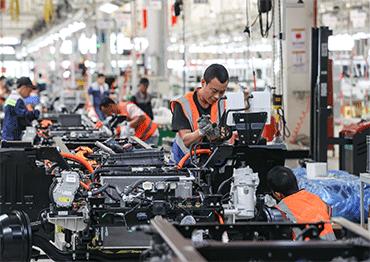
A worker assembles a truck at a new-energy auto plant, Gui’an, Guizhou Province, July 2, 2025 (Photo by VCG)

Print