Old Version
International

Contingency or Provocation?

Japanese Prime Minister Sanae Takaichi’s framing of a Taiwan contingency as a threat to Japan’s survival is widely seen as a direct challenge to the post-World War II settlement, contradicting Japan’s longstanding political commitment that Taiwan is part of China

By Yu Xiaodong Updated Feb.1

When right-wing Japanese politician Sanae Takaichi became Japan’s prime minister in October 2025, many observers were concerned it would lead to a deterioration in China-Japan relations. But few expected she would ignite tensions so quickly.  

Responding to a question from an opposition lawmaker during a Diet session on November 7, Takaichi stated that a “Taiwan contingency” could constitute a legally binding condition under Japan’s controversial security legislation enacted in 2015 that would allow Japan to exercise its right to “collective self-defense.” In other words, Takaichi suggested that Japan would intervene militarily in a Taiwan conflict. 

Taiwan and WWII Order 
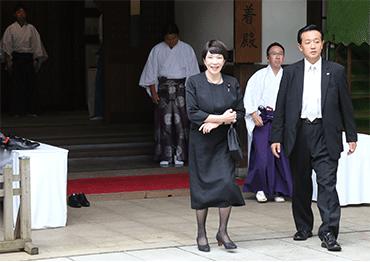
Having visited the controversial Yasukuni Shrine in Tokyo, where some convicted Japanese Class-A war criminals are venerated, five times in the 16 months prior to taking office, Takaichi has long been known as an unapologetic nationalist and a China hawk. She is widely considered the torchbearer of late Japanese prime minister Shinzo Abe’s political legacy, who had raised the idea that any contingency concerning Taiwan would be an emergency for Japan in 2021.  

While Abe made this remark only after he stepped down from office, without specifying what kind of emergency it meant for Japan, Takaichi became the first sitting Japanese leader to publicly declare a so-called Taiwan contingency as an existential threat to Japan and link it to possible use of force.  

Her remarks triggered strong reactions from China. On November 13, Chinese Vice Foreign Minister Sun Weidong summoned Japanese Ambassador to China Kenji Kanasugi, warning that Takaichi’s remarks challenge the core interests of China and seriously undermine the political foundation of China-Japan relations.  

China’s Ministry of Culture and Tourism and the Ministry of Education soon issued notices advising Chinese tourists and students to avoid traveling to Japan, leading to the cancelation of many cultural exchange events. It is estimated that more than 1,900 flights involving 16 Chinese airlines between the two countries were canceled in December. China also halted imports of Japanese seafood and suspended talks on resuming Japanese beef imports.  

The China Coast Guard intensified patrols around the disputed Diaoyu Islands, known as the Senkaku in Japan. China’s military, the People’s Liberation Army (PLA), has conducted several live-fire drills in the Bohai Sea and Yellow Sea since late November.  

China’s strong reaction stems from its assessment that Takaichi’s remarks not only violate the one-China principle, but also constitute a clear indication that Japan intends to overturn the post-war international order.  

Defeating China in the first Sino-Japanese war (1884-1885), Japan forced China’s ruling Qing government to cede Taiwan in 1895, ruling the island for 50 years until the end of WWII. The 1943 Cairo Declaration, signed by the US, Britain and China, stated that “all the territories Japan [had] stolen from the Chinese” were to be restored, including Taiwan. The 1945 Potsdam Declaration reaffirmed this, and Japan formally accepted it in its Instrument of Surrender.  

On this basis, China considers the restoration of Taiwan a key element of the post-WWII international order and Taiwan’s status as an integral part of China as settled in 1945. Earlier in October 2025, China’s National People’s Congress officially designated October 25 as the Commemoration Day of Taiwan’s Restoration.  

Furthermore, when China and Japan normalized relations in 1972, they signed a joint communique, then later signed agreements known as the four political documents, in which Japan stated that it “fully understands and respects China’s position that Taiwan is an inalienable part of China.”  

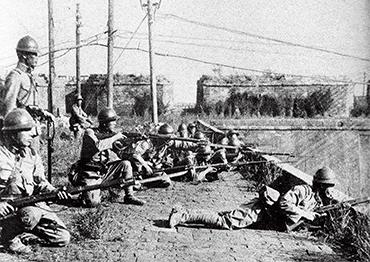
Given Japan’s historical colonialism in Taiwan and wartime aggression, Takaichi’s use of a “survival-threatening situation” to justify potential military action regarding Taiwan evokes memories of past occasions when Japan cited alleged survival crises to justify aggression, including the September 18th Incident (Mukden Incident in 1931 in China’s northeast), the  July 7th Incident  (Lugouqiao or Marco Polo Bridge Incident in Beijing) in 1937, and the surprise attack on the US’s Pearl Harbor in Hawaii in 1941.  

“What’s Prime Minister Sanae Takaichi up to by reviving the phrase ‘survival-threatening situation?’ Is Japan going to repeat its past mistakes of militarism?” asked Lin Jian, a spokesperson for China’s Foreign Ministry at a regular press briefing on November 13. Calling Takaichi’s comments a “blatant provocation to the post-WWII international order” and “a serious blow to China-Japan relations,” Lin warned that “if Japan should dare to meddle in the cross-Strait situation, it would be an act of aggression and definitely meet a firm response from China.” 


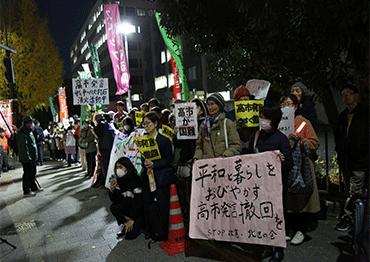
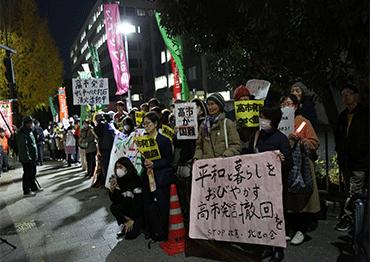
Hundreds of Japanese citizens protest against Prime Minister Sanae Takaichi’s Taiwan remarks outside her offfce, Tokyo, Japan, December 4, 2025 (Photo by VCG)

Rise of the Far-Right 
For many Chinese observers, Takaichi’s provocative remarks reflect the rapid rise of right-wing ideologies in Japan’s political landscape. Right-wing forces in Japan advocated expansionist ambitions and justified aggression before WWII, and have been holding negationist views toward Japan’s past aggression against other Asian countries. These forces are also pursuing revisions to Japan’s pacifist constitution that it adopted after WWII.  

“Takaichi’s comments reflect a fundamental shift in Japan’s political dynamics, as the country’s long-dormant postwar conservative ideology resurfaces and merges with growing populist frustrations amid the country’s relative decline,” Xiang Haoyu, a research fellow at the Department for Asia-Pacific Studies at the China Institute of International Studies, told NewsChina.  

As part of the post-WWII international order, Japan adopted a pacifist constitution that renounces the right to launch a war as a means of settling international disputes. For decades, Japan had adopted an “exclusively defense-oriented” policy.  

In the meantime, Japan was allowed to preserve its imperial system and many elements of its militarist structure, as the US considered Japan an important ally during the Cold War. “Unlike Germany which dismantled its Nazi legacy, Japan never fully confronted the factors that led it to war. Instead, those political, institutional and ideological elements were largely preserved,” Zheng Yongnian, director of the Advanced Institute of Global and Contemporary China Studies at the Chinese University of Hong Kong (Shenzhen), said in an interview with media outlet GBA Review on November 20.  

The most prominent example is Nobusuke Kishi, a member of Japan’s wartime cabinet and a suspected Class-A war criminal. Seen as a valuable anticommunism figure, Kishi was released by the US without trial after three years in prison, paving the way for him to become Japan’s prime minister between 1957 and 1960. One of Kishi’s central aspirations was to revise Japan’s pacifist constitution. Kishi is regarded as the icon of the postwar right-wing forces in Japan. His political legacy was later embraced by his grandson Shinzo Abe, and is now passed on to Takaichi. 
 
“A large number of Japanese war criminals were never held accountable after WWII and many returned to, and even thrived in postwar politics, the military establishment and the business world. This not only made it impossible to fully pursue wartime responsibility for wartime atrocities, but also laid the groundwork for the resurgence of right-wing forces in Japan,” Yang Bojiang, director of the Institute of Japanese Studies at the Chinese Academy of Social Sciences, pointed out in a commentary published by bimonthly Party magazine Qiushi in December.  

After several decades of rapid economic growth, the Japanese economy started to stagnate in the 1990s. In 2010, China surpassed Japan to become the world’s second-largest economy. “Japan fell into what many call ‘Japan’s lost three decades,’ with its national strength in decline, and this accelerated the rightward shift in Japanese politics and fueled a broader conservative drift across society,” Yang said. 

Nationalist Agenda 
In the past 10 years, Japan has sought to gradually hollow out its pacifist constitution.  

In 2015, under the Abe administration, Japan passed a controversial security legislation, which relaxed its constitutional interpretation to enable the exercise of the right of “collective self-defense,” precisely the concept Takaichi evoked. In December 2022, Japan announced plans to acquire a “counter-strike capability” to attack enemy bases preemptively. In 2023, Japan revised its arms export policy  to permit the overseas sale of lethal weapon systems co-developed with foreign partners.  

“Takaichi’s hardline right-wing posture is driven by a nationalist ideology that can be traced back to the prewar ‘imperial historiography,’” Xiang Haoyu said. “It seeks to break away from what it considers an overly self-critical, shame-inducing ‘masochistic’ view of history. While refusing to acknowledge Japan’s wartime aggression and rejecting the verdicts of the Tokyo Trials as a foundational historical conclusion, it calls for the restoration of ‘pride and dignity’ of the Yamato nation, and reclaim Japan’s past stature as a major power,” he said.  

Given Takaichi’s right-wing position, the centrist Komeito Party withdraw from the ruling coalition, ending a 26- year partnership with the Liberal Democratic Party (LDP), which has been in power almost constantly since it was founded in 1955, except for two periods of three years. The LDP instead formed a coalition government with the populist right-wing Nippon Ishin, or Japan Innovation Party.  

Less than one month into her tenure, Takaichi has advanced a nationalist agenda far beyond the Taiwan Strait. In the same Diet session on November 7, Takaichi reaffirmed Japan’s claim to the Dokdo islets, known as Takeshima in Japan, intensifying its territorial disputes with South Korea over the islands and prompting Seoul to postpone a planned joint naval search-and-rescue drill. 

On November 11, Takaichi pledged to revive visits by former residents to the Russia-controlled islands off Japan’s far north, reigniting rows with Russia over the disputed islands. On the same day, she also refused to endorse Japan’s Three Non-Nuclear Principles that Japan will not “produce, possess or host nuclear weapons,” a commitment formulated in 1965 and adopted by the Japanese government since then.  

On November 13, citing various Japanese officials, Japanese newspaper The Sankei Shimbun  reported that Tokyo is advancing plans to revise the rank designation system of the Japan Self-Defense Forces, replacing the current numbered ranking system with traditional military titles used by the Imperial Japanese Army and Navy during WWII.  

On November 23, during a trip to Yonaguni, an island about 110 kilometers east of Taiwan, Japan’s Defense Minister Shinjiro Koizumi told reporters that the country is planning to deploy medium-range surface-to-air missiles on the islands.  

According to a November 17 report by USNI News, a publication under the US Naval Institute, Japan is rapidly expanding its long-range strike capabilities and recently tested a new hypersonic missile system. The first version, Block I, with capability to strike targets hundreds of kilometers away, is expected to enter active service in 2026, and future Block 2 and 2B variants of the missile are expected to have a range of between 2,000 to 3,000 kilometers. In addition to hypersonic weapons, Japan plans to deploy Tomahawk cruise missiles, Joint Strike Missiles and upgraded Type 12 surface-to-ship missiles in the coming year.  

All of these moves mark a significant and substantive shift in Japan’s postwar defense posture. 
UN and US 
On November 21, China’s Permanent Representative to the United Nations Fu Cong submitted a letter to UN Secretary-General António Guterres elaborating on the Chinese government’s position. Stressing that Japan is a defeated country of WWII and does not possess collective self-defense rights, the letter states that China can invoke the “enemy state” clauses in the UN Charter, meaning that if Japan uses force over Taiwan, China could launch a counterattack in accordance with international law.  

The Chinese Embassy in Japan also posted on X, stating that the “enemy state” clauses, or Article 53 and 107 of the UN charter, allow the victors of WWII – China, France, the Soviet Union, the UK and the US – to take military measures against former Axis powers, chiefly Germany, Italy and Japan, should they pursue aggressive policies, without requiring prior authorization from the UN Security Council.  

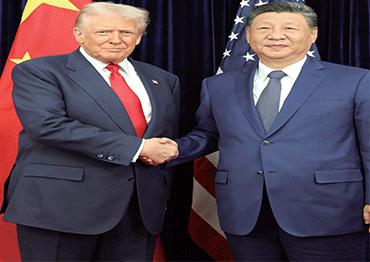
The spat  between the two countries unfolded not long after the meeting between Chinese President Xi Jinping and US President Donald Trump held in Busan, South Korea on October 30, when the two leaders agreed on a temporary truce on their trade disputes. Given the military alliance between the US and Japan and the US’s positioning of China as a strategic rival, Washington’s stance became a focal point. On November 25, Xi spoke on the phone with Trump in their first call after the Busan meeting.  

According to the Chinese Ministry of Foreign Affairs, Xi reiterated China’s principled stance on the Taiwan question, stressing that Taiwan’s return to China is a key part of the postwar international order, while Trump said the US acknowledges the significant role China played in the victory in WWII and understands the importance of the Taiwan question to China.  

Within hours, Trump spoke with Takaichi over the phone. Although neither Washington nor Tokyo acknowledged that the two leaders discussed the disputes between China and Japan, The Wall Street Journal reported that Trump had advised Takaichi not to provoke China on Taiwan. 

Escalation or De-escalation 
While Tokyo has denied the report, Takaichi has apparently walked back some of her original remarks, but has still refused to clarify Japan’s stance on Taiwan. When questioned in a Diet session on November 26, Takaichi said her government only maintains “nongovernmental working-level relations” with Taiwan. While recognizing that Japan has “renounced all rights and claims under the Treaty of San Francisco,” she still insisted that Japan is “not in a position to recognize Taiwan’s legal status.”  

Her reference to the Treaty of San Francisco met with a new backlash from China. The treaty was signed by 49 nations in 1951 to re-establish peaceful ties with Japan, which includes Japanese renunciation of its claims to Taiwan, but it does not specify China’s sovereignty over Taiwan. China was not invited to the San Francisco Summit, and deems the treaty “illegal and null and void.”  

At a press conference on November 27, Chinese Foreign Ministry spokesperson Guo Jiakun criticized Takaichi for attempting to “hype up the so-called ‘theory of undetermined Taiwan status.’” Arguing that the San Francisco treaty goes against the Declaration by United Nations signed by 26 countries, including major allied countries in 1942, which prohibits a separate peace with enemy states as stipulated, Guo stressed that Taiwan’s legal status as an integral part of China has already been settled in relevant international documents, which Japan acknowledged in the 1972 Sino-Japanese Joint Statement.  

In an apparent further step back, Takaichi said in another Diet session on December 3 that Japan’s position on Taiwan has not changed since the 1972 Japan-China joint communique. China again rejected her remarks.  

“‘No change to the position’ is far from adequate and certainly unacceptable as a response to China,” Chinese Foreign Ministry spokesperson Lin Jian said on December 4, “If Japan’s fundamental position on Taiwan is indeed as stated in the 1972 Sino-Japanese Joint Statement, can Prime Minister Takaichi accurately and fully articulate that position?” Lin said. “China’s stance is very clear: We urge the Japanese side to reflect on and correct its wrongdoing, and retract Prime Minister Takaichi’s erroneous remarks. This is an issue of principle,” he added.  

According to Xiang Haoyu, given Japan’s domestic political dynamics, it is unlikely that Takaichi will explicitly retract her Taiwan contingency remarks. “Takaichi’s political rise has been built upon her image as a conservative hawk, and any sign of compromise would be seen as a betrayal that could put her leadership at risk,’” Xiang said, “Therefore, keeping a tough nationalist posture remains the preferred option.”  

Meanwhile, the tension between the two countries’ militaries appears to be escalating.  

On December 7, Japan’s Defense Ministry alleged that a Chinese J-15 fighter jet from the aircraft carrier Liaoning locked radar on a Japanese F-15 twice on December 6 in international waters southeast of Okinawa’s main island. China countered that the event was prompted by the Japanese fighter’s attempt to intrude into China’s training area to conduct close-in reconnaissance and interfere with China’s military activities.  

As Takaichi remains reluctant to retract her remarks, no clear path to stabilizing China-Japan relations is now in sight. If Japan’s security policy continues to shift rightward further, the two countries may be headed for a prolonged period of confrontation in the foreseeable future.

Sanae Takaichi (left), Japan’s then minister of state for economic security, visits the war-linked Yasukuni Shrine, Tokyo, Japan, on August 15, 2023, the same day as the 78th anniversary of Japan’s unconditional surrender in World War II (Photo by VCG)

Print