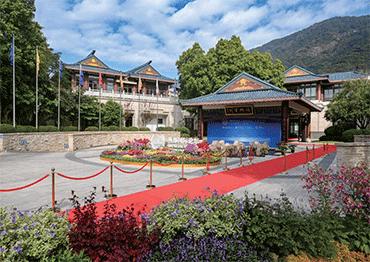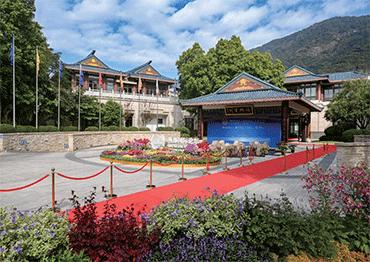
Imperial Springs, the venue of the forum, is a resort in Conghua Liuxi River Ecological Reserve, Guangzhou, Guangdong Province (Photo by CNS)
From December 1 to 3, the 2025 Imperial Springs International Forum, co-hosted by the Chinese People’s Association for Friendship with Foreign Countries, the Australia-China Friendship and Exchange Association, the Guangdong provincial government, and the World Leadership Alliance-Club de Madrid, was held in Guangzhou. This year’s theme was “For Global Cooperation and Solidarity.”
More than 200 participants, including former heads of state and government, leaders of international organizations, as well as Chinese and foreign scholars and business executives from over 30 countries, held in-depth discussions on major global issues such as security challenges, global governance reform, trade frictions and AI regulation. They reaffirmed their commitment to multilateralism and urged all parties to strengthen unity and cooperation to meet shared challenges.
At the opening ceremony, Yang Zhen, vice chairman of the National Committee of the Chinese People’s Political Consultative Conference, said China’s major global initiatives on development, security, civilization and governance offer Chinese wisdom for solving global challenges, and said that China is a “doer” when it comes to putting these ideas into practice.
In 2024, Chinese President Xi Jinping sent a congratulatory letter to the forum, noting that over the past decade the Imperial Springs International Forum has remained committed to promoting multilateralism, conducting in-depth discussions on global governance and sharing China’s proposals. For three consecutive years, President Xi met with forum attendees in Beijing in 2017, 2018 and 2019.
Over the past decade, the forum has drawn more than 200 senior international political figures and over 600 Chinese and foreign scholars and business leaders. In December 2024, after the forum concluded in Madrid, UNESCO designated Imperial Springs as a “world peace practice base.”
Chau Chak Wing, founding president of the Australia China Friendship and Exchange Association, told NewsChina that the forum’s creation and growth reflect the needs of a rapidly changing world. “The more differences we have, the more we need dialogue; and the greater the challenges, the more we must communicate,” he said.
Nearly all the participants repeatedly expressed concerns over challenges and crises that the world faces today, including the Russia-Ukraine conflict, the Israel-Palestine crisis, rising geopolitical rivalry, countries openly challenging the postwar international order, tariff conflicts and “decoupling” threatening globalization, as well as the US backtracking on climate commitments and global AI governance falling behind rapid technological change.
Danilo Türk, president of the World Leadership Alliance-Club de Madrid and former president of Slovenia, warned at the opening ceremony that few had expected the world order’s sense of certainty to unravel so quickly. Two years ago, he told NewsChina that multilateralism was being undermined. Now, the stability of the global trading system is also under severe pressure, driven by the tariff war launched by the Trump administration, Türk said. He told media during the forum that he worries the world is moving in a dangerous direction.
The year 2025 marks the 80th anniversary of both victory in the World Anti-Fascist War and the founding of the United Nations. Many senior political leaders said today’s crises highlight the need to safeguard and reform the postwar international order based on multilateralism.
Former South Korean prime minister Han Seung-soo argued that more worrying than great-power conflict is what such tensions reveal: the weakening of the UN system. Romano Prodi, former prime minister of Italy, noted that so-called “trade wars” are not conflicts between ordinary people but products of political division and unilateralism.
Türk emphasized that China’s four major global initiatives offer a shared framework for strengthening multilateralism.
On October 20, the International Organization for Mediation was inaugurated in Hong Kong. Türk described the institution as a new global public good contributed by China.
Former Canadian prime minister Kim Campbell said China’s commitment to international governance aligns with Canada’s values, and that Canada welcomes China’s constructive role in reinforcing the multilateral system.
At the forum, guests could scan a QR code to place a coffee order. A robotic arm would then select ingredients and create patterned foam. Within a minute, a robot-made latte with “Imperial Springs International Forum” printed on top was ready.
Vaira Vīķe-Freiberga, co-chair of the Nizami Ganjavi International Center and former president of Latvia, told NewsChina that in the digital age, technology should have made people more empathetic and understanding, yet information channels are still used to spread bias. Sitting at the same table, she said, does not constitute dialogue if participants arrive with ffxed views and simply wish to impose them on others.
Former Norwegian prime minister Kjell Magne Bondevik and former Austrian chancellor Sebastian Kurz stressed that dialogue must extend beyond governments and include academia and other sectors.
At the closing ceremony on December 3, Türk said participants had reached a shared understanding: the world urgently needs a platform that can bridge geopolitical divides, encourage the exchange of ideas, foster dialogue, and drive action. The Imperial Springs International Forum provides exactly that, he said.
“Today, unilateralism is resurging, the international system is under strain and global challenges are escalating. How to reform and improve global governance and safeguard global stability and prosperity has become a pressing question,” Chau Chak Wing said. He added that the Imperial Springs International Forum will continue to “bring together the power of unity, uphold the banner of cooperation and work toward a fairer future.”
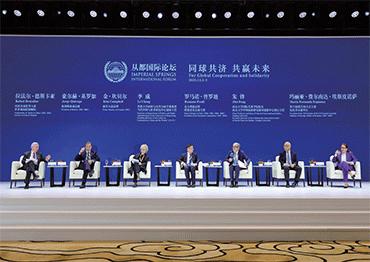
Guests participate in a panel discussion during the Imperial Springs International Forum, Conghua District, Guangzhou, Guangdong Province, December 3, 2025 (Photo by CNS)
 Old Version