Old Version
Economy

No Quick Fixes

NEV manufacturers’ tight grip on maintenance and spare parts is hindering the aftersales market, which will hurt the sector in the long run, experts say

By Xu Ming , Chen Huaishan Updated Feb.1

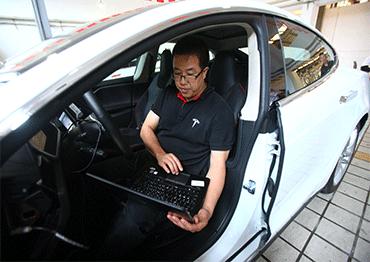
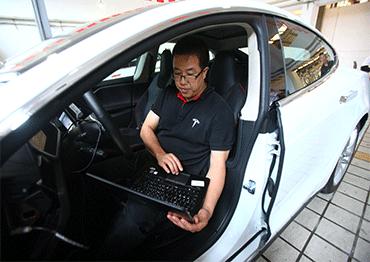
A Tesla maintenance technician connects to a vehicle with a laptop to service it, Ningbo, Zhejiang Province, June 11, 2015 (Photo by VCG)

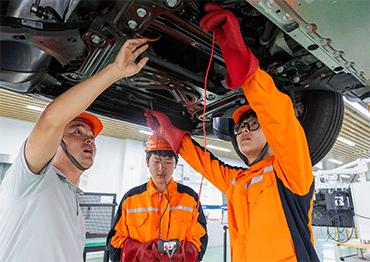
Student mechanics are taught how to inspect and maintain new energy vehicles at Wuhu Mechanical Engineering School, Wuhu, Anhui Province, September 2025 (Photo by VCG)

In September 2025, auto repair influencer Brother Long revealed that he was ordered to pay 100,000 yuan (US$14,052) to electric vehicle maker XPeng, who had sued him for spreading false statements and defaming XPeng’s products. Three other automakers, including conglomerate BYD, had also previously taken him to court for posting videos in which he commented on problems relating to repairing their vehicles. He told media he had to pay a combined 7 million yuan (US$983,647).  

BYD announced in October 2024 it was suing Brother Long for publishing false statements, spreading rumors and defaming its products in his videos. But some netizens believe it is because his videos, in which he analyzes the problems of new energy vehicles (NEVs) and offers cheaper solutions, have stepped on the toes of automakers. The case once again stirred discussion over the prolonged vexation of NEV maintenance in China.  

In 2024, there were 31.4 million registered NEVs nationwide, and by October 2025, sales surpassed those of fuel-powered vehicles for the first time. Despite this, customers complain the repair market for NEVs is afflicted with high costs and long waits as owners are often forced by warranty agreements to only use auto shops affiliated with NEV brands.  

Meanwhile, independent auto shops that offer more competitive prices are shut out of the repair business. Repairing NEVs involves not only specialized technologies but also data supervision from automakers. Since NEVs are connected to the internet, modifying the data of core components such as batteries is considered illegal if vehicles are under warranty.  

In late 2024, two Shanghai auto mechanics, “Big Liu” and “Little Liu” were convicted of “damaging computer information systems” after using specialized tools to unlock NEV battery packs, bypassing the manufacturer’s official procedures. The owners wanted to fix their vehicles more quickly and at lower cost. Their unauthorized modification of battery management data compromised its accuracy. Both received six-month suspended sentences.  

The case mirrors the multiple maintenance dilemmas for NEV owners. It involves the interests of automakers, consumers and repair companies – but in a David and Goliath situation, big automakers retain dominance as their control of core technical data and proprietary parts, ensuring non-affiliated maintenance options are limited.  

Since 2016, China has implemented a warranty policy of eight years or 120,000 kilometers for core components of NEVs. By 2024, the first batch of NEV core components were no longer under warranty, which means as the market continues to expand, aftersales protocols urgently need adjusting to better support NEV development in the future, interviewed analysts said. 

Repair Monopoly 
“The [Shanghai] case stirred fierce discussion among repair companies,” said Cao Xuejun, vice president of Jingyou Technology, a claims assessment and settlement platform. He said it is a typical instance involving NEV repair in that the “automakers need to protect their vehicle data, as regulated, but it clashes with consumers’ interests.”  

Li Ming, a third-party auto shop owner in Beijing, told  NewsChina  that his company has repaired some NEVs. But the legal precedent in Shanghai’s Jiading District made him realize the potential consequences of “unauthorized unlocking.”  

Ensuring the authenticity of collected data is mandatory for regulatory authorities. In March 2022, the regulatory body of industry and information technology, public security, transport and other agencies issued a guideline on strengthening safety systems of NEV enterprises, demanding continuous monitoring of the operational safety status of sold NEVs and requiring the uploading of monitoring data in accordance with standards, guaranteeing the timeliness, authenticity and validity of submitted data.  

The regulation raised concerns that only channels authorized by automakers have the right to unlock batteries if a collision leads to battery locking, a safety feature installed in NEVs to prevent fires and electric shocks in high-voltage systems.  

Cao Xuejun said that since fuel vehicles are primarily mechanical, it is hard for manufacturers to restrict where they are repaired. However, NEVs require connection to the manufacturer’s systems, which allows them to remotely lock vehicles.  

Locking battery packs is just one of the issues causing friction between automakers and third-party repairers. NEV manufacturers have long been blamed for dominating the maintenance market. They use encryption technologies, data access restrictions and warranty clauses to ensure retention of maintenance rights over the core electrical systems within authorized channels.  

Some NEV repairs may involve modifications to software systems that could compromise driving safety and which are viewed as an infringement of automakers’ intellectual property rights. NEV manufacturers are reluctant to share the rights to repair the three core electrical systems – the power battery, drive motor and electronic control system – the most lucrative NEV components. 

“Automakers may authorize unaffiliated auto shops to undertake bodywork and painting, but they’ll never let outsiders touch core electrical systems,” Song Quanye, an automotive aftermarket expert, told NewsChina.   

Locked-in Warranties 
NEV companies usually stipulate in their purchase agreements that repairs must be conducted through certified channels or owners risk voiding the vehicle’s warranty. This allows automakers to keep NEVs still under warranty inside the manufacturer-established maintenance ecosystem. 

AITO, a brand of electric vehicles under the Seres Group that incorporates Huawei technology, requires that repairs involving Huawei’s DriveONE electric drive system or in-vehicle systems be performed by Huawei-certified engineers or no warranty will be provided. Similarly, BYD’s lifetime warranty for the three core electric systems states that it will be invalidated if the owner “fails to perform maintenance at a BYD-authorized service center” or “uses nongenuine BYD parts for maintenance or repairs.”  

This limits the options for consumers, many of whom complain of the high costs of using an authorized “4S” dealership. These are one-stop full-service shops for drivers in China, providing four services – sales, service, spare parts and surveys (feedback to automakers). An NEV owner from Chongqing told local media he had to pay 1,300 yuan (US$183) to get an oil and filter change at an official 4S dealer, double the price of a regular garage.  

“If I don’t get work done at an authorized 4S dealer, my warranty will be canceled. I just have to put up with the price,” the owner told newspaper the Chongqing Legal System in July 2025. 

Adding to the issues owners face, the NEV spare parts market is highly restricted. Manufacturer constraints on supply channels usually result in high prices for parts.  

“If the market size for a particular model is small, third-party manufacturers are reluctant to produce components for it,” an employee at a car components manufacturer told NewsChina on condition of anonymity. “For fuel vehicles, there are usually genuine parts made by official equipment manufacturers (OEMs) and secondary market parts, which helps reduce maintenance costs to some extent. However, if an NEV model sells only tens of thousands of units, secondary manufacturers naturally lack the incentive to produce compatible parts.”  

Brake on Aftersales 
Another bottleneck is the insufficient number of authorized repair shops, also a constraint on competition. Li Ming said the process is hard. He tried to get authorization from several automakers three years ago, but found that even brands that only authorize third-party body work and paint jobs require applicants to operate more than one 4S shop, preferably representing luxury auto brands.  

The high threshold not only keeps maintenance costs high but also significantly increases the difficulty and risks associated with repairs, interviewed experts noted.  

Li once helped an NEV owner whose car, with a rated range of 400 kilometers, could only travel 70-80 kilometers on a single charge. Since the car had been driven over 300,000 kilometers in four years, it no longer met the warranty conditions. But the official repair shop’s solution of replacing the entire battery pack would cost him more than 80,000 yuan (US$11,248). In the end, Li only replaced the damaged battery cell, reducing the cost to around 2,000 yuan (US$281).  

Tang Yifan, an NEV owner living in Chongqing, told local media that in the city center, there is only one authorized maintenance center for the brand he purchased. It takes a long time to get service there. “Once it took more than two weeks to get it fixed,” Tang told the Chongqing Legal System in July.  

Song Quanye argues that automakers’ restrictions on unauthorized repairs prevents a virtuous cycle in third-party NEV maintenance from forming. A lack of service centers capable of repairing NEVs is just one consequence.  

“Currently, it’s hard to find third-party repair shops specializing in NEVs. Only Tesla-related business is viable,” Song said.  

He noted that many third-party NEV repair shops have emerged this year, primarily repairing Tesla vehicles. This is because the first batch of domestically produced Model 3 and Model Y cars are just out of warranty. Tesla’s popularity is also sufficient to sustain these repair shops’ business. In contrast, most vehicles from domestic automakers are still within warranty. Some, like BYD, even offer lifetime warranties. 

Technical Roadblocks
For third-party auto shops, the challenge is not only lack of authorization, but also technical barriers. “Even with a new [combustion] engine model, mechanics can disassemble and reassemble it with 100 percent restoration. There are virtually no technical barriers to repairing fuel vehicles,” Song said. “But when it comes to NEVs, especially the three electrical systems, many mechanics won’t touch them.”  

Core battery technologies remain proprietary, and the high-voltage electrical systems in NEV batteries pose significant risks. If a mechanic makes even a slight error, it could result in a severe electric shock.  

For example, according to new NEV maintenance standards rolled out in Shenzhen, Guangdong Province, in January 2025, businesses must possess both operational qualifications and certified technicians. Mechanics must obtain certification from an authorized institution or complete training provided by manufacturers, and have a low-voltage electrician license.  

The manager of an auto repair shop in Chongqing told the Chongqing Legal System that among the eight technicians at his shop, only one holds an electrician’s license. With no authorization from NEV manufacturers, the shop has to limit its services to basic tasks such as tire changes, exterior modifications, paint and body repairs.  

Another auto repair shop owner from Chongqing, Liu Qingping, said that less than 10 percent of vehicles they repair are NEVs. “We hope to expand our NEV business, but vehicle owners won’t let us touch core components, and we’re not trained to do it either,” Liu said. 
 
According to the China Automotive Maintenance and Repair Trade Association, there are around 400,000 enterprises related to fuel vehicle maintenance and repair, but only 20,000-30,000 for NEVs. There are fewer than 100,000 NEV mechanics nationwide.  

“Training NEV mechanics takes a long time, and there aren’t many college courses,” Zhang Xiang, a research fellow at the Automotive Industry Innovation Research Center at North China University of Technology based in Beijing, was quoted as saying in an article published on cctv.cn in November 2025.  

It seems counterintuitive that while owners complain of long waits and poor service, mechanics do not have enough NEVs to learn on.  

“Automotive repair requires training and extensive hands-on experience. However, the current market lacks enough NEVs for repair. Without enough vehicles to practice on, the skills they learn will be obsolete within a year or two,” aftermarket expert Song said.  

Wang Hao, founder of Kebola, an automotive consulting firm based in Qingdao, Shandong Province, has noticed the mismatch between demand and supply in the aftersales market for NEVs. He told NewsChina that NEV manufacturers and core parts suppliers have been relatively slow in promoting technological transparency and circulation of spare parts, creating de facto monopolies and barriers to fair service, which has prevented the development of the NEV service aftermarket from meeting demand.  

In 2015, transportation and commerce authorities ordered automakers to disclose technical maintenance and repair information for all vehicles sold to all service centers and buyers.  
But in reality, Cao Xuejun said that despite the requirements, problems persist, including slow updates of technical maintenance information and cumbersome procedures for third-party repairers to get data from manufacturers.  

As 10 years have passed, the measures on technical information disclosure should be revised, interviewed experts said. When it comes to NEVs, government agencies should provide guidance on how much third-party repair shops should pay to access the technical information necessary for repairs, and punish companies that refuse to disclose this information.  

In January 2025, authorities issued guidelines on NEV insurance, which called on enterprises to lower the cost of NEV repairs by enriching supply channels and varieties of NEV parts, and to encourage NEV and battery enterprises to support sales of spare parts for the three core electrical systems.  

Wang Ligang, an expert in NEV aftersales, noted in an interview with China Automotive News in May 2025 that the opening up of the aftermarket for fuel vehicles had also relied on laws and regulations to push manufacturers to give access to spare parts, repair information and service channels.  

But he added that besides the willingness and attitude of automakers, pressure over profits and the competence of third-party repair shops are obstacles to an open market. “As NEV ownership increases and manufacturers’ profitability pressure eases, they’ll have no option but to open up the spare parts market, repair information and service channels,” Wang said.

Print