The Siku Quanshu, also known as the Complete Library in Four Sections, was compiled during the reign of Qing Dynasty Emperor Qianlong (1735-1796). The emperor initiated the project to preserve the vast body of Chinese classics accumulated since the pre-Qin period (before 221 BCE). Beginning in 1772, the compilation took more than a decade to complete, with Emperor Qianlong personally overseeing the work.
The project was carried out by an editorial board of more than 360 scholars, led by the renowned writer Ji Yun. Another 3,800 scholars participated in transcription. In its complete form, the collection comprises about 3,500 works in 36,000 volumes, totaling roughly 800 million characters.
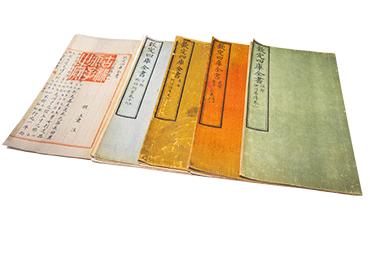
The Siku Quanshu is organized into four sections: Confucian classics, historical records, philosophical writings and literary and miscellaneous works. Each section was assigned a color corresponding to the four seasons: green for spring, red for summer, blue for autumn and taupe for winter, making navigation and reference easier.
After the compilation was completed, Emperor Qianlong ordered seven handwritten copies to be produced and stored in seven specially built libraries across the country. Four were placed in imperial palaces in the north for the emperor’s use, while three were located in the south for public access.
Only four of these copies have survived to the present day. They are housed at the National Library of China in Beijing, the National Palace Museum in Taipei, Gansu Provincial Library in Lanzhou, and Zhejiang Library. Among them, Zhejiang Library’s copy is the most complete.
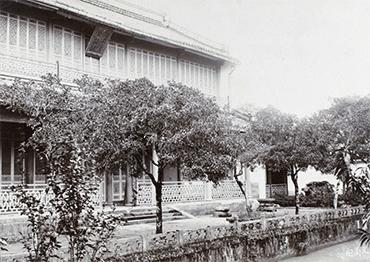
This version was originally stored at Wenlan Pavilion near West Lake in Hangzhou. Built in 1784, the pavilion is itself a masterpiece of classical Chinese garden architecture. Set within a traditional courtyard, it is a wooden pavilion with a layered roof and double tiers of eaves, giving it a dignified appearance.
From the outside, the structure appears to have two stories, with the upper and lower levels forming a single large space. Inside, however, an additional mezzanine level was concealed, creating extra storage capacity. This design balanced visual elegance with practical efficiency and was particularly suited for housing books. A pond was also dug in front of the pavilion to provide water for fire prevention.
Craftsmen were commissioned to bind and box the volumes according to imperial standards. The books were shelved by category on different floors of the pavilion, with Confucian classics on the first floor, historical records on the second and philosophical and miscellaneous works on the third.
Emperor Qianlong issued an edict allowing the public to read and copy texts within the pavilion. As a result, Wenlan Pavilion functioned as a public library by the standards of its time.
As the Taiping Rebellion swept through Hangzhou in the 1860s, Wenlan Pavilion suffered extensive damage and its collection was dispersed. Many volumes were taken away, some by looters and others by book collectors.
Around that time, brothers Ding Shen and Ding Bing noticed a market vendor wrapping food in loose book pages. Recognizing an imperial seal on one of the pages, they realized the fragments came from the Siku Quanshu. As dedicated book collectors, the brothers began an effort to recover the lost texts. They tracked down missing volumes and repurchased what they could. They also secretly entered the abandoned Wenlan Pavilion with a small group and transported the remaining books to safety.
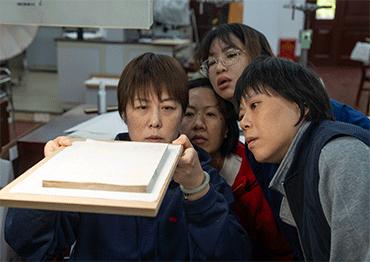
Although most of the recovered materials consisted of fragmentary chapters or incomplete volumes, they accounted for about one quarter of the original Wenlan Pavilion collection. Determined to restore the remaining three quarters, the Ding brothers sourced replacement texts from private libraries and hired craftsmen to hand copy the missing sections.
The restoration effort was later taken over by Zhejiang Library, which was founded in 1900. By the 1920s, the library had reassembled the entire collection. Since then, the Siku Quanshu has been not only a prized holding of the Zhejiang Library but also a symbol of continuity in China’s cultural preservation and transmission.

 Old Version