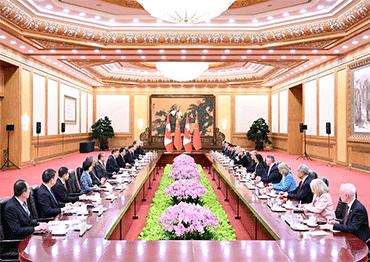
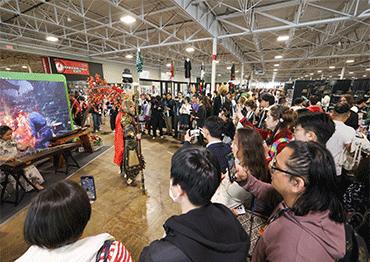
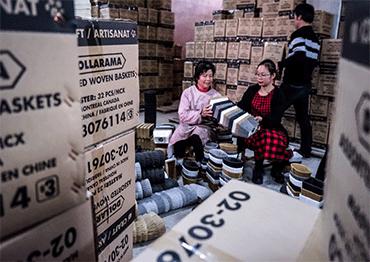
While Carney’s trip focused primarily on promoting economic cooperation and trade, its timing, amid widening rifts between the US and its Western allies that are fueled by Trump’s “America First” agenda and intensified by disputes such as Greenland, prompted speculation about the broader geopolitical significance.
On January 20, just three days after his visit to China, Carney delivered a well-received keynote speech at the World Economic Forum Annual Meeting 2026 in Davos, Switzerland.
Emphasizing there is “a rupture in the world order,” Carney said that middle powers like Canada can no longer pretend that the US-led “rules-based international order” still exists in a world “where the large, main power, geopolitics, is submitted to no limits, no constraints.”
Calling it “partially false” and a “pleasant fiction,” Carney declared Canada “the first” to wake up to the reality and that it has decided to “fundamentally shift our strategic posture.”
Pointing out that Canada has signed 12 trade and security deals on four continents in six months, including with China, Carney said that Canada is diversifying to “hedge against uncertainties.” Carney also stressed that Canada “stands firmly” with Greenland and Denmark, and “fully supports their unique right to determine Greenland’s future.”
Without directly naming the US, Carney’s remarks were widely interpreted as a veiled critique of recent US actions and policies, which quickly drew sharp criticism from Trump.
During Carney’s visit to Beijing, Trump publicly said it was fine for Carney to pursue a deal with China. “If you can get a deal with China, you should do that,” Trump told reporters at the White House.
After Carney’s outspoken Davos speech, however, Trump threatened to impose a “100 percent tariff” on Canadian goods if Ottawa pursues a comprehensive trade deal with Beijing, framing such a deal as undermining US interests.
In response, Carney emphasized that Canada has no plans to pursue a full free-trade agreement with China and that the recent tariff changes are limited in scope. Canadian officials reaffirm Canada’s commitments under the United States-Mexico-Canada Agreement (USMCA).
When asked about Trump’s threat against Canada, Guo Jiakun, a spokesperson for China’s Foreign Ministry said on January 26 that the trade arrangements between China and Canada are not directed at any third party. Guo stressed that “China holds that all countries should handle relations with each other in a win-win rather than zero-sum manner, and in a cooperative rather than confrontational way.”
As the US continues to have strong influence on Canada’s foreign policy, some scholars have cautioned against overstating the significance of Carney’s trip to China.
Zhang Juan, managing editor of the Chinese language US-China Perception Monitor (zmyinxiang.org) launched by the Carter Center, warned in a commentary published on January 14 that while Trump’s pressure on traditional allies may have prompted them to seek to diversify their partnerships, these countries still must carefully balance growing engagement with China against their economic and security dependence on the US.
While China can play a role in its export diversification strategy, Canada’s foreign policy will continue to center around the US in the foreseeable future, Zhang added.
“Carney’s visit was neither a comprehensive pivot nor a full breakthrough. Rather, it amounted to a cautious testing of the possibilities for closer ties with China amid a turbulent international landscape,” Zhang said.
Zhang’s view was echoed by Cheng Hongliang, a research fellow with the China Institutes of Contemporary International Relations in Beijing. In an interview with domestic media guancha. cn, Cheng said that as a key member of the US-led alliance system, the US still has a dominant influence on Canada’s foreign policy.
As Washington now treats AI, energy and critical minerals as areas of strategic importance, any Chinese investment in these sectors will face both strong US and domestic opposition in Canada, Cheng added.
According to Cheng, the significance of Carney’s visit is that with a more clear-eyed understanding of its relationship with the US, Canada no longer aligns its China policy with Washington’s.
“From Canada’s standpoint, it may never fully escape US influence, but it will develop its relationship with China based on its own national interests with a more pragmatic approach,” Cheng said.
 Old Version