Old Version
Culture

Tragic Twists

As China’s micro-drama industry booms, grueling schedules, lack of clear standards and weak protection of rights are putting those in the industry at serious risk

By Wang Shihan Updated Apr.1

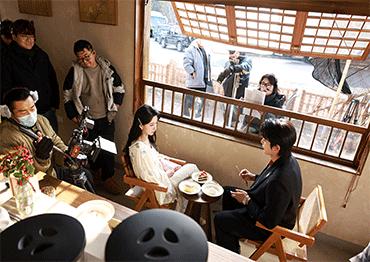
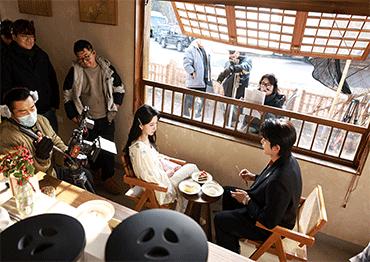
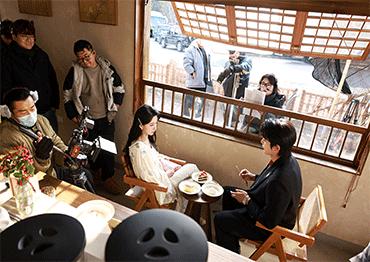
The film crew films micro-drama Love in the Morning and Evening at Sixi Homestay in Baliwan Village, Dongyang, Zhejiang Province, January 22, 2026 (Photo by VCG)

Director Gao Jun (ffrst from left) on set, October 2025 (Photo Courtesy of the Interviewee)

Wang Fei walked in on her husband lying unconscious on the floor. She found Gao Jun in the bathroom of their home in Kaifeng, Central China’s Henan Province on October 20, 2025. It was 4 pm. 

Two hours later, doctors at a local hospital announced Gao had died of a heart attack. The 48-year-old director had just completed a four-day shoot for a micro-drama project. 
 
Actor Chen Li was part of the production. “He was really a good person, very mild-mannered,” Chen told NewsChina. “Because we had to finish filming in four days, most of us could only sleep three or four hours a day.”  

Though Gao’s death came as a shock, many in the micro-dramas industry are familiar with the heavy workload he endured, a result of its boom in recent years. Often shot to be viewed on phones, micro-dramas are bite-sized series with episodes that last one to two minutes, designed for short-video platforms such as Douyin and specialized apps like HongGuo. These productions are known for fast-paced melodrama, complete with cliffhangers, plot tropes and stereotypical characters.  

Major production hubs include Xi’an in Shaanxi Province, Zhengzhou in Henan Province, and Hengdian World Studios in Zhejiang Province. In Zhengzhou alone, there are more than 820 micro-drama production companies, 40 large-scale filming bases and over 30,000 people working in the industry. Every day, more than 100 new micro-dramas begin filming in the city.  

The micro-drama market reached 90 billion yuan (US$12.9b) in 2025 and is expected to surpass 100 billion yuan (US$14.3b) soon, according to Le Li, chief editor of HongGuo, China’s leading short-drama platform, at the Conference on the Creation of HighQuality Radio and Television Content in Beijing on October 29, 2025. This nearly doubled the market size in a single year, up from 50.4 billion yuan (US$7.2b) in 2024.  

Yet behind the industry’s explosive growth are significant risks. Intolerable work intensity, the absence of standardized employment practices and insufficient protection of workers’ rights have cast a shadow over the sector’s rapid expansion. 

Death Scene 
Gao Jun, well known for his documentary and ad work, entered the ultrashort drama industry in August 2025, working at what was ultimately an unsustainable pace.  

Between August and September, Gao had already completed four micro-drama projects. From October 14 to 18, he filmed his fifth project in Zhengzhou, Henan Province, serving as executive director. The entire shoot was completed in just four days.  

Wang Fei said she had never fully understood her husband’s working conditions. “He rarely talked about his work with the family over the past two years,” she told NewsChina. Wang herself was not a fan of micro-dramas, preferring traditional long-form television series.  

Only after Gao’s death, when she reviewed his message history and step-count on his phone, did Wang realize the intensity of his workload. Gao worked more than 17 hours a day and walked over 12,000 steps daily. He typically returned to his hotel around 2 am, slept for just three or four hours, and returned to work by 7 am.  

After wrapping up the project, Gao returned home on October 18. From his WeChat chat history, Wang discovered that he had told a friend he was suffering from severe insomnia. At 11 am on October 20, Gao messaged the project’s chief director, Liu Aiguo, apologizing for mistakes he had made due to exhaustion. 

 “Maybe I slept too little. I almost blacked out on set. I’ve never experienced anything like this before,” Gao wrote.  

At 9 pm that same day, Wang informed Liu of her husband’s death via message. “We were all shocked and deeply saddened by the loss of such a wonderful person,” Liu told NewsChina. “He was diligent, proactive and meticulous in his work.” Gao often told Liu he was “always ready” to take on any task.  

Wang said her husband had long suffered from hypertension and took medication daily, but he had no known heart disease. He exercised regularly, hiking and swimming. She firmly believes that his sudden death was directly linked to extreme overwork.  

Actor Chen Jun said he has yet to recover from the shock of Gao’s death and declined all job offers for three months afterward.  

Over the past two years, Chen participated in eight micro-drama productions. On one occasion, he said, he filmed continuously for 40 hours without rest. During shoots, he repeatedly took traditional Chinese medicine used for acute chest pain. 
 
“There is no time to rest when filming short dramas,” Chen told NewsChina. “Rain or shine, filming never stops. We just keep going.” 

‘Warning Signs’ 
Gao’s extreme workload is common in the micro-drama industry.  

Many told NewsChina that 12-hour workdays are the bare minimum, with 16-hour days far more common. Overnight shoots are routine.  

Producer Yao Guoli entered the industry after graduating in 2024. He first worked at a studio in Xi’an, Shaanxi Province on a micro-drama with a shoestring 160,000 yuan (US$22,912) budget, compared to the average 400,000- 700,000 yuan (US$57,000-100,000) per production, according to a November 2025 white paper issued by the China Netcasting Services Association. 

To cut costs, he and another producer alternated overnight shifts. Eventually, the other producer quit from exhaustion, leaving Yao to handle the workload alone.  

At one point, Yao worked for two days straight with only two hours of rest. 

 “I was completely burned out,” Yao told NewsChina. “My memory quickly got worse. I couldn’t focus or even speak clearly.” 

In November 2024, Yao joined a toptier micro-drama production company in Xi’an. Since then, he has worked on more than 30 productions. According to him, an 80-episode project is typically filmed in six to nine days, while a 40-episode production takes four to five days. Between productions, crews usually get no more than three days off before starting again.  

As a man in his early 20s, Yao believed his body could take it. “But when a friend saw me after nine months, he said bluntly, ‘You look so old now,’” Yao said.  

Pan Le, a producer who recently transitioned from traditional long-form television to micro-dramas, spent one month working at Hengdian World Studios in Zhejiang Province, China’s largest micro-drama production base. In that short time, he noticed what he described as “dangerous warning signs” among colleagues.  

“Due to sleep deprivation, some actors start speaking incoherently,” Pan said. “But filming won’t stop for anyone who felt unwell. Some directors developed heart problems and had to quit because their health was truly at risk. When someone left, they were quickly replaced.” 
 
According to industry insiders, budget size largely determines working conditions. Productions with sufficient funding can afford more reasonable schedules.  

“In March 2025, when my company had more investment, we started filming at 9 am and wrapped around 8 or 9 pm,” Yao said. “We even had time for late-night snacks. But recently, as investment across the industry has dried up, budgets have been severely cut.”  

One of a producer’s key responsibilities is drafting the daily filming schedule, known as “the big plan.” Yao said this task often left him feeling desperate.  

“Many projects realistically need eight days to shoot, but because of budget constraints, they’re compressed into six,” he said. “You have to squeeze an impossible workload into fewer days.”  

Budget cuts have sharply intensified labor demands. One industry practitioner, who requested anonymity, told NewsChina that the most exhausting project he worked on involved filming a 100-episode micro-drama in just four days.  

“No one escapes the pressure,” he said. “From directors and producers to actors, cinematographers, costume designers and prop teams.” 
‘Old Problems’ 
Beyond excessive workloads, there are serious gaps in labor protection.  

With the exception of a few top-tier companies, most micro-drama producers hire cast and crew on a temporary basis without formal contracts. Recruitment relies on verbal agreements about pay. Without written contracts, workers have little recourse when disputes arise.  

Ma Huixia, who leads a costume and styling team at Hengdian World Studios, said she encountered her first payment dispute after years in the television industry.  

In August 2025, Ma’s team agreed to provide services for a micro-drama project for 139,000 yuan (US$19,900). Although payment by installments was agreed upon, no formal contract was signed. The producers provided only a draft contract, promising it would later be signed by their boss.  

Before filming began, a new producer replaced the original two. During production, Ma’s team worked 19 to 20 hours a day and completed all assigned tasks. However, they received only the initial payment of 55,600 yuan (US$7,959). The remaining balance was withheld, with the explanation that the company’s boss refused to sign the contract.  

Zhang Qi, a partner at Shanghai Landing Law Firm, told NewsChina that Ma’s team should have insisted on a signed contract from the outset and retained all evidence of cooperation, including formal invoices.  

She noted that because micro-drama production cycles are extremely short, many procedures are handled informally, making disputes more likely. Temporary actors often sign no contracts at all, and wages are frequently paid in cash without written records.  

Safety protections are also lacking on set.  

Pan Le attributed this largely to budget constraints. “Normal film and TV sets usually have ambulances, medical staff, rest areas and basic support facilities,” he said. “All of that costs money. On micro-drama sets, these safeguards simply don’t exist.”  

At Hengdian alone, hundreds of micro-dramas are filmed every month. “You can’t realistically have medical teams and ambulances assigned to every project,” Pan added.  

Yao also pointed out that despite widespread overtime, most crew members receive no overtime pay. Only toptier celebrities or foreign actors are able to demand rest periods or compensation after 12 to 14 hours of work.  

After decades working in traditional television, Pan has witnessed the industry’s gradual move toward standardization.  

“The micro-drama industry seems to have inherited all the old problems of film and television,” he said. He called on production companies to take greater responsibility for protecting workers’ rights.  

Gao Jun’s death, Pan said, should serve as a wake-up call.  

Gao and Wang Fei have two young daughters. “For now, I don’t want to tell them what their father did for a living,” Wang said. “If one day they truly love this industry, they can choose to follow his path.”  

She hopes that by then, the micro-drama industry will be more mature and standardized, and that tragedies like her husband’s will never happen again.

Print