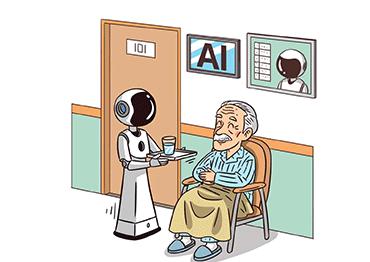
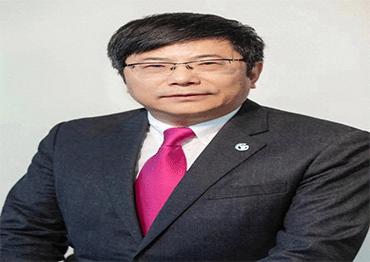
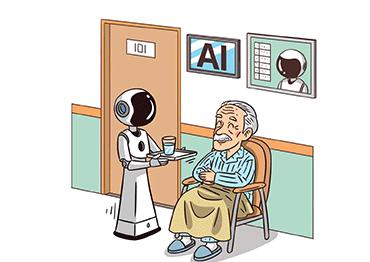
"Accelerating the development and adoption of AI-powered elder care technology, such as assistive devices, care robots, smart nursing beds, companion robots and home-assistant robots, and building a new ‘AI + human' care model is the most practical, feasible and humane solution to addressing population aging."
Chen Wei, presidential aide at the Third Affiliated Hospital of Zhejiang Chinese Medical University (Zhejiang Zhongshan Hospital) and NPC delegate, during the 2026 two sessions
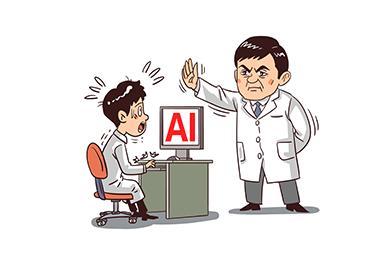
"China's current AI governance focuses on content security, data compliance and algorithm ethics, but lacks a systematic mechanism to address AI's impact on employment. If this institutional gap is not filled in time, it could evolve into a major threat to social stability."
Ma Yide, dean and chair professor of the School of Intellectual Property at the University of the Chinese Academy of Sciences and a delegate to the National People's Congress (NPC), during the 2026 two sessions
"If humans lose solitude, they will lose the ability to think. Without independent and in-depth thinking, originality will dry up. We should set aside some time for screen-free deep reading to preserve the mental space that nurtures creativity."
Mai Jia, vice-chairman of the China Writers Association and NPC delegate, writing for the People's Daily in March
"By linking women's childbearing contributions to their social security, this institutional design recognizes the social value of women's childbearing and protects their pension rights. It can also ease enterprises' burdens and promote fairness in both the pension system and the protection of women's social rights."
Zheng Gongcheng, president of the China Association of Social Security and a member of the NPC Standing Committee, proposing during the 2026 two sessions a "mother's pension" to ensure women's pension contributions are not suspended or reduced during childbirth and childrearing
"The same clichéd slogans... are seen in every corner of China. Tourist souvenirs equally lack innovation. Refrigerator magnets are a nice travel souvenir, but we need better cultural and tourism products."
Dai Bin, director of the China Tourism Academy and a member of the Chinese People's Political Consultative Conference (CPPCC), on domestic tourism marketing in a March interview with news website CNR.
"[Economic] growth has become overly structural and concentrated in a handful of isolated sectors. While expansion in these sectors may boost real GDP growth, it cannot bring about macroeconomic balance and stability, and in some extreme cases may even lead to growth without development."
Zhang Jun, dean of Fudan University's School of Economics in Shanghai, writing for financial portal Yicai in late February
"There would be no cross-border trade if production in each country only meets domestic market demand. The US side should not narrowly define production capacity that exceeds domestic demand as ‘overcapacity' and label it as such. The US also has no right to unilaterally determine whether its trading partners have ‘overcapacity' through Section 301 investigations and impose unilateral restrictive measures."
China's Ministry of Commerce responding to the US Section 301 trade investigation aimed at 16 economies including China under the pretext of overcapacity
"[These children]are often left in a state of long-term neglect, having missed the critical period for developing their personality, emotions and moral character. This creates many hidden risks for their future growth and can lead to psychological problems."
Qian Xueming, chairman of the Guangxi Zhuang Autonomous Region Committee of the China National Democratic Construction Association and CPPCC National Committee member, proposing during the 2026 two sessions, a shift in approach from running boarding schools for left-behind children in rural China to creating urban schools for migrant workers' children so they can move to cities with their parents
 Old Version