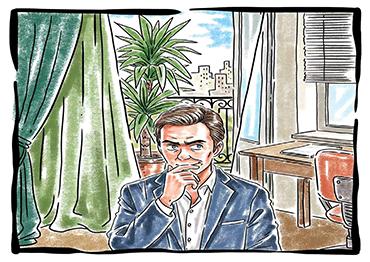
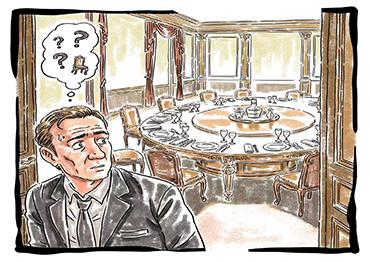
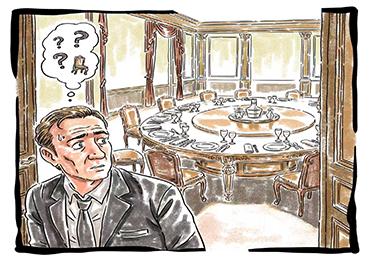
remember the feeling of terror well. I can see myself standing in the doorway like a statue. It was the first time I ever attended a formal dinner in China. Round tables with revolving lazy Susans filled the hall, and every chair seemed to carry a hidden meaning. I had heard numerous stories about foreigners accidentally taking the seat of honor and mortifying their hosts, so I lurked by the door until a colleague gently guided me to a seat well away from the entrance.
In China, every dining table is a carefully calibrated map of relationships. Indeed, in the complex culture of Chinese dining, seating order is probably the most important part of each banquet. For a start, it is vital that foreigners know that no one should sit down before the senior person or guest of honor has taken their place. When dining on a round table the most coveted and prestigious seat faces the door. The positions to its right are considered second, fourth, sixth in importance, and those to its left are third, fifth, seventh. In a charming twist, the host usually takes the least prominent seat. If you arrive early, you will not find place cards. Instead, you will find a room of people waiting until the key guests arrive. That wait is not about indecision, rather it is about humility.
This hierarchical approach to seating can seem intimidating, but it arises from a culture that values harmony and respect for age and status. Confucianism teaches that each person has a role within the group, and in China every table embodies that lesson. Placing a respected elder or honored guest at the far side of the table acknowledges their social standing, while the host's As a lifelong vegetarian I initially flinched with horror when the head of a whole fish was pointed towards me at one particular dinner, before learning that this was considered a sign of respect and honor Imodest position signals hospitality rather than dominance. Once you understand the logic, it becomes less like a game of musical chairs and more like a ritual of mutual deference.
Dining etiquette extends beyond who sits where, it also extends to how and where the food itself is placed. Indeed, when the assorted dishes first arrive, someone will start to turn the lazy Susan. This process is a veritable art, because even the direction of turning matters and represents information about the status and relationships of those present. Moreover, there are many other small courtesies foreigners need to be aware of. For instance, spinning the tray while someone else is serving is considered very rude. You should also never let the spout of the teapot point at a person because in Chinese symbolism the spout suggests expelling someone. It is also worth knowing that special dishes are usually placed in front of the honored guest and then rotated clockwise. As a lifelong vegetarian I initially flinched with horror when the head of a whole fish was pointed towards me at one particular dinner, before learning that this was considered a sign of respect and honor.
The same sensibility surfaces in the conference room. In Chinese meetings the highest ranking person enters first, and your hosts will assume that the first member of your group to walk in is your leader. When everyone is inside, there is another silent dance. The most senior guest takes the central seat. While in some cultures we feel the need to fill breaks and pauses with small talk, in China you may find yourself greeted by deliberate silences. It has taken me a long time not to interpret these silences as awkwardness. They are opportunities for reflection. I have learned to enjoy such pauses instead of filling them with nervous jokes.
For outsiders, the easiest way to navigate these customs is to follow your host's lead. Wait to be seated. Make a note of which seat faces the door and who sits there. In a business context, be aware of how you and your colleagues enter the room and how you sit. When the lazy Susan rotates, take a modest portion and let others serve themselves. If you are unsure about anything, a quiet question is better than a bold assumption. Chinese hosts tend to appreciate the effort more than perfect execution.
After more than a decade in China these rituals no longer terrify me. I still occasionally misjudge the revolving tray and chase a dumpling around like a cat following a laser pointer, but I no longer dread the seat facing the door.
Instead, I smile at it, grateful that someone else will be offering the first toast. Understanding where to sit has taught me not just about etiquette but about a culture that expresses respect through small, tangible acts. The chairs around a Chinese table are like words in a sentence: in the right order they create harmony, and when you read them correctly, the whole scene makes sense.
 Old Version