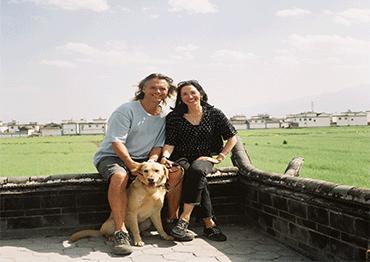
In 2004, Linden and his wife made a decision that their friends and family found astonishing: They sold their house in the US and moved to China with their two young sons, Shane and Bryce.
This time, they were looking for a rural place that had not been homogenized by globalization to create "a center that would be a vehicle for real cultural and intellectual exchange," he wrote in his memoir One Village at a Time.
The Linden family spent two years visiting rural towns across the country to look for a potential site. Finally, they arrived at Xizhou, near the tourist hotspot of Dali.
"This was the very place we were looking for," Linden said. "People here were very warm, open and very tolerant. The local government was tolerant as well. And, in China, it was rare to find large, traditional pieces of architecture that still retained their integrity."
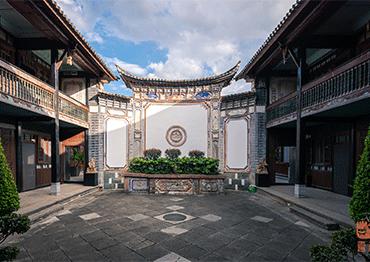
Amid golden rice fields, Linden discovered a building that would become the centerpiece of his life's work: Yang Pinxiang Mansion. The 1,800-squaremeter mansion is laid out in traditional Bai architectural style: three square buildings with a screen wall, four adjoining courtyards and five skylights. Though listed in 2001 as national heritage site, the mansion had been neglected for years.
Linden applied for permits to renovate it, putting up his life savings of about 6 million yuan (US$883,151). At the time, a foreigner volunteering to restore a national cultural relic was unprecedented in China. The local government approved him, and over the next 18 months, Linden poured all his money into the project, working with dozens of Bai craftsmen to restore the old mansion to its former glory.
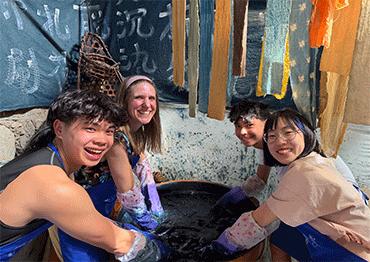
In 2008, the first Linden Center opened its doors. Linden and his team offered cultural activities like Bai dancing, music and handicraft workshops, as well as calligraphy classes, morning market tours and cooking lessons.
One morning in late April, Wang Xia, a 35-year-old Bai woman from Xizhou, was wrapping up her morning market tour. On staff at the Linden Center, Wang is a guest manager, guide and organizes cultural activities.
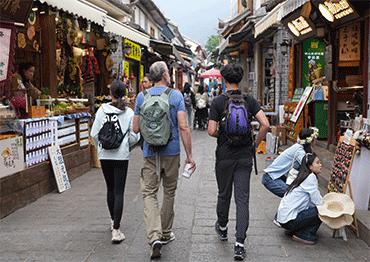
The morning market tour is one of the Linden Center's most popular activities. The guide leads visitors through the alleys of Xizhou to see vendors, many in traditional Bai clothing, selling foods like edible flowers, dry mushrooms and fresh blueberries. Also for sale are Yunnan specialties such as rushan (dried milk cake) and erkuai (rice noodle). Guests can buy ingredients for cooking classes back at the Center.
"International guests are really drawn by this morning market tour and the Chinese cooking class," Wang said.
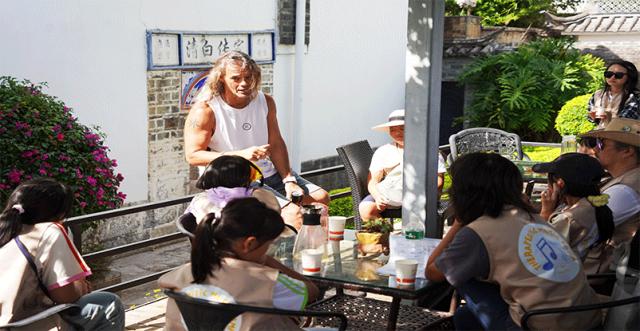
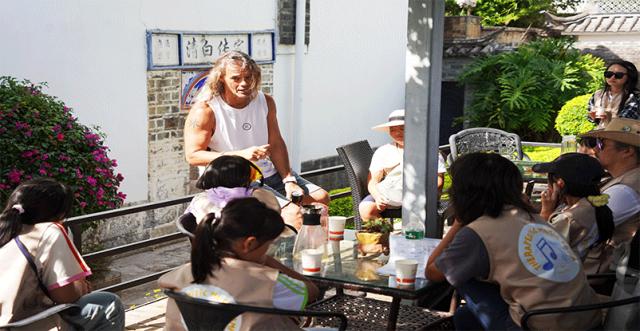
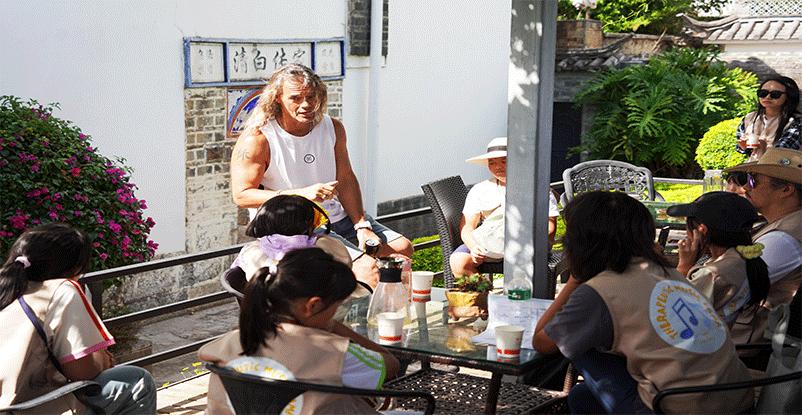
The Linden Center puts a lot of effort into building a community. It holds a free cultural event once a month, hosting activities such as English corners, painting sessions and singing, Wang said. Around Christmas, they hold embroidery classes to teach children to make coasters.
On January 29, Wang's two daughters joined a singing activity for children, where they were taught to sing John Denver's "Take Me Home, Country Roads."
Now there are two more Linden Centers in Xizhou - Yangzhuoran International Education Base and Bao Chengfu. Linden Centers have also expanded to other towns, like Shaxi, an ancient town around 100 kilometers from Xizhou and Naada in Shangri-La, in the north of Yunnan Province.
Cai Mengqi, former Asia-Pacific head of green finance at the UN Environment Program (UNEP), views Linden as a "super go-getter." Cai is the founder of Yunnan Zhengfei, a cultural tourism platform that started collaborating with Linden Centers in early 2026.
"There's one big trait in Brian that everyone can probably feel - his passion. You can feel that passion in every word he says, in every interaction he has with people. I feel that people nowadays seem to be losing passion for things. But it's passion that gives life direction, and good luck may follow, because many people are drawn in by his passion," Cai told NewsChina.
 Old Version