ows of stilt houses roofed with gray tiles nestle snugly against terraced paddy fields. Amid the undulating rice stalks, ducks seek small fish and insects. Beyond the rustic and unadorned farmland, sonorous and vibrant folk songs reverberate among the mountains, with rhythms and rhymes resonating down the centuries.
Situated deep in the Miaoling Mountains, a watershed dividing the Pearl and Yangtze Rivers, Huanggang Village, a settlement of the Dong ethnic group in Southwest China's Guizhou Province, was designated as one of the world's best tourism villages by the UN World Tourism Organization in October 2025. It is the first village in Guizhou to receive the honor.
The Best Tourism Villages initiative has honored 236 villages in 57 countries since it was established in 2021.
Over the past 800 years, the lifestyle of the Dong in Huanggang has seen little change. The symbiotic ecological system of rice paddies, ducks and fish remains and the people's songs and rituals have survived the tide of modernity.
However, over the past 12 years with improved transportation, especially since the Guiyang-Guangzhou High-speed Railway and the Xiamen-Chengdu Expressway were put into operation in 2014 and 2017, tourists from both home and Rabroad have flocked there.
With increasing recognition, tourism started to thrive. In 2024, there were 36,800 tourist visits to the village, a year-on-year growth of 35 percent, and revenue hit 16.6 million yuan (US$2.43m), up 36 percent. Among all sources of income, several former traditional granaries have been renovated, providing 38 rooms for guests which have contributed 1.24 million yuan (US$174,000) to the local economy.
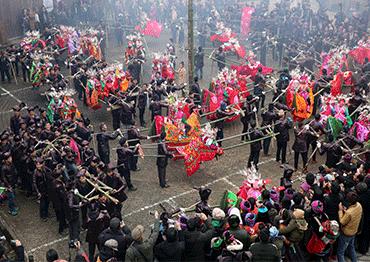
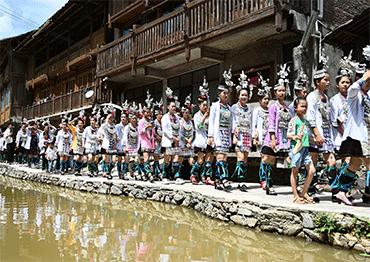
In this age-old Dong settlement, travelers can feast on fish they caught themselves in the paddy fields and listen to the Grand Song of the Dong, an intangible cultural heritage of humanity inscribed by UNESCO in 2009, while still benefiting from modern facilities in guesthouses.
Different from Provence in France or Italy's Tuscany, where old architecture and cultural legacies have been preserved, the Dong settlement in Huanggang offers an "immersive experience," Xing Qishun, deputy director of the Institute of Culture, Guizhou Academy of Social Sciences, told China News Service in April.
China News Service: Why has Huanggang Village become a center of attention in global rural tourism?
Xing Qishun: The Dong settlement of Huanggang Village boasts a history of over 800 years. With its ancient customs [oral conventions covering forestation, marriage, families and ecological conservation] and village elder system [respected elders elected to take charge of local affairs] adapting well to today's tourism, the age-old wisdom of the village has played a distinctive role in modern social governance.
Renowned as a living relic of ancient Dong culture, the village offers an immersive experience rather than passive sightseeing for visitors as a way of cultural preservation.
Culturally speaking, the village's vibrant Grand Song of the Dong epitomizes how rural areas can be revitalized by intangible cultural heritage.
As one of the cradles of the [Grand Dong] folk song, an intangible cultural heritage of humanity inscribed by the UNESCO in 2009, Huanggang Village is home to the male-voice version of the song (multi-part singing with no musical accompaniment, telling of their history, with choirs divided by age group or gender). An old saying among locals goes: "Food nourishes the body, and songs nourish the soul."
At the same time, an ancient ecological closed loop formed by rice, fish and ducks has been well preserved. In the paddy fields, the fish and duck droppings both loosen and enrich the soil. With ducks, the rice is immune to pest infestations. The virtuous circle of the agricultural system embodies harmony between humans and nature.
With a high forestation rate, clear water and terraced paddy fields, ecological conservation has been achieved through the efforts of local people's voluntary protection and the ancient traditions passed down from one generation to another.
The renovated granaries are another highlight. Equipped with modern comforts inside, the facades have been preserved, maintaining the panoramic scenery of the entire village.
Featuring age-old cultural heritage and ecologically well-protected natural scenery, the village has pursued sustainable development to improve local livelihoods without eroding their traditional way of life, thanks to its innovative tourism model and unique system of community governance.
CNS: How has Huanggang retained its dynamic lifestyle? How do visitors experience this?
XQ: The development model driven by culture, innovation and community construction has contributed essentially to the village's vitality. The deep integration of culture, life and tourism has formed an organic system capable of self-upgrading and reviving.
By wisely utilizing local governance with modern institutions, the village has ensured it has retained a major and decisive role in local tourism development.
The concerted efforts among two committees (the village committee of the Communist Party of China and the village committee), the centuries-long traditions passed down and respected village elders have all encouraged village development and preservation. The villagers are entitled to self-governance on small issues and all parties make joint efforts to address major ones. To ensure that decisions on development are beneficial to the interests of the entire community, elders hold discussions in the village's ancient drum tower, applying their wisdom from village rules and the handed-down traditions.
By integrating indigenous traditions into modern consumer demand, the village has created new industrial models rich in cultural cultivation. As a result, young locals who sought more opportunities in bigger cities are starting to return, opening guesthouses, restaurants or starting folk bands to sing the local ballads. Making good use of traditional resources, these youngsters spread culture on social media platforms.
While exploring development, all the villagers share the dividends. For instance, tourism income collected by local rural cooperatives is distributed to all villagers, enabling them to be the main body and major beneficiaries of rural revitalization.
Therefore, we should attribute the village's path to success to community initiative underpinned by its unique governance system, dynamic cultural immersion and innovations driven by intrinsic motivation.
CNS: How does Huanggang compare to European rural open-air museums, Japan's "satoyama" system and Asia- Pacific indigenous communities?
XQ: Instead of being preserved as a museum, Huanggang Village allows people to experience indigenous lives. That is different from "open-air museums" in European villages, such as in Provence (France) and Tuscany (Italy), where architectural clusters and artistic atmosphere are protected intact to show the resplendence and profundity of these ancient landscapes.
However, in Huanggang Village, immersion is more important than observation for tourists to appreciate local lives.
Young people there sing the Grand Song of the Dong to convey romantic feelings. The drum tower is where villagers discuss public issues, enjoy the cool breeze and socialize. Meanwhile the stilt houses and granaries show how people live and store crops. Tourists to the villages can enjoy many rural activities, such as transplanting rice seedlings in spring, catching fish in summer and harvesting crops in autumn, just like local farmers. These deep immersive experiences are unavailable in sightseeing-oriented rural areas dubbed as "open-air museums."
The satoyama landscapes in Japan (satoyama refers to ecological zones between human-managed land and natural ecosystems) are based on an ecological system formed both by natural rules and human interventions. The guiding principles for its ecological management and environmental conservation are more like a philosophy.
Asia-Pacific indigenous communities [in places] like the Philippine Ifugao Rice Terraces and Subak Irrigation System in Bali [Indonesia] have faced challenges including traditional culture loss and population outflow under the impact of modernization. Tourism in those regions is restricted to sightseeing trips out of concern for protection of local cultural relics, legacies and customs.
Combining cultural inheritance, ecological conservation and community governance, tourism in Huanggang Village has succeeded in upholding ecological, cultural and economic values (for instance, growing local glutinous rice).
Huanggang Village is neither an openair museum, nor an ecological reserve. It requires no passive protection. It is really a dynamic entity driven by inner motivation and full of energy.
CNS: How does Huanggang Village strike a balance between economic development and ecological conservation?
XQ: Huanggang uses ecological conservation as both the prerequisite and goal of development. Ecological resources and traditional culture are essential driving forces of sustainable development. This is how we have reaped substantial benefits from the harmonious integration of green ecology, booming economy and well-off livelihoods.
The ancient traditional pact on logging has been passed down to this day. Logging is only allowed for public projects endorsed by collective decisions. Meanwhile, in line with the pact and village rules, new houses must be built of wood to maintain harmony with the surrounding architecture. The village allows no brick buildings. That is our fundamental rule in preserving the form of the settlement, surrounded by mountains and waters.
The agricultural system of rice, fish and ducks lays a solid foundation for the local ecological loop. It protects the water and soil and has become one of the world's most important agricultural legacies. The panoramic view of the fragrant glutinous rice fields is appealing. Interested tourists can experience plucking tea leaves in spring, catching fish in summer, harvesting crops in autumn and brewing rice wine in winter.
Culinary delicacies such as pastries made of fragrant glutinous rice, dried fish, salted duck eggs and rice wine are delivered across the mountains by the local cooperative.
A closed loop of protection, development and distribution created a virtuous circle with shared benefits for all in the village. Supervision and operation based on traditional authority and general consensus have avoided excessive commercialization and destructive development. While translating ecological values into economic gains, we have upheld our bottom line and reached strong consensus that ecological conservation is conducive to individual livelihoods.
The development of traditional villages relies on exploring ecological values. Conserving natural resources, whether terraced fields, ancient woods or unique water systems, is a precondition and essential foundation for rural heritage preservation and revitalization. A sustainable rural lifestyle depends on the adoption and evolution of time-honored ecological wisdom.
If they retain their distinctive and vibrant lifestyles then Chinese villages can present a convincing and touching story to global audiences.
 Old Version