Wang Kecheng, founder of construction robotics company Patner, landed his first overseas order in France after exhibiting at a trade show in 2024.
Their tile-laying robot was featured by local media, which caught the attention of a major construction company dealing with persistent labor shortages.
Patner only makes a tile-laying robot and a system that lays out survey lines to map out construction sites. Wang says this is a deliberate choice.
"They're both difficult products to develop, but they solve high-value problems in specific construction scenarios," Wang said. These conditions include covering large areas with simple perimeters.
The company claims their tile-laying robot works five to six times faster than a human worker while reducing overall construction costs by about 60 percent. By the end of 2025, Patner had received more than 10 million yuan (US$1.5m) in orders, with overseas markets accounting for 55 percent.
Labor shortages continue to drive demand, Wang said. In parts of Europe and the US, where building codes are strict, skilled tradespeople command high wages. Tile installers in the US average around US$25 an hour, and for custom work demand US$75 or more.
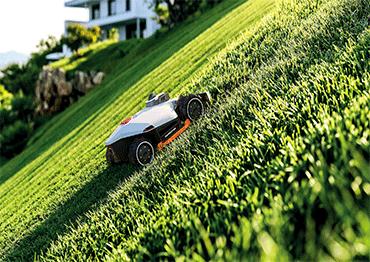
Landscaping is another growth area, and Shenzhen-based robotics company Mammotion is looking to cut in. The firm entered the robotic lawn mower market in 2022, competing against long-established European names like Husqvarna in Sweden and Germany's Bosch.
Most conventional robotic mowers require burying perimeter wires around property lines, making installation labor-intensive. Mammotion eliminated that step by adapting high-precision positioning technology originally developed for drones.
The innovation propelled the company to become the world's best-selling wire-free robotic lawn mower brand between July 2024 and June 2025, according to Frost & Sullivan. Its products are now sold in more than 30 countries and regions, serving over 400,000 homes.
Its wire-free mowers retail for US$2,599-4,999, roughly 50 percent more than conventional models.
"The higher price gives us room to keep investing in new technologies," said a Mammotion employee who works in developing international markets. Instead of competing through price cuts, the company is positioning itself as a premium brand before expanding market share. He described the company's strategy as "taking technology around the world to find scenarios where customers are willing to pay."
This approach appears to be reshaping the market. China's lawn mower exports reached 13.2 billion yuan (US$1.9b) in the first seven months of 2025, up 56.6 percent year-on-year, with wire-free models driving much of the growth.
"Global customers are under increasing pressure to reduce costs and improve efficiency," Xie Kaixuan, marketing director at Dobot Robotics, told China Business Journal in May. "Chinese manufacturers benefit from deeply integrated supply chains that allow us to move quickly from order to delivery."
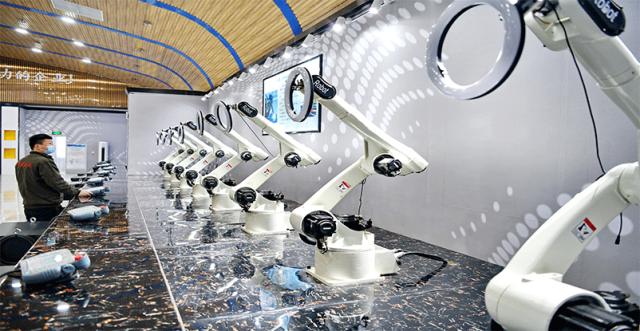
The Shenzhen-based company has established branches and R&D centers in more than 12 countries and regions. Its robots are used in over 200 applications across 15 industries, from auto manufacturing to medical surgery and retail.
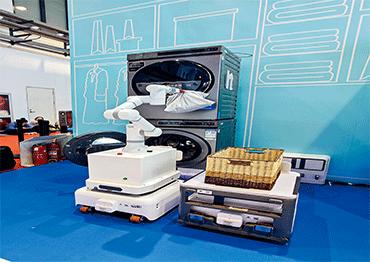
"For many emerging robotics companies, going global is no longer optional," said Fan Yazhou, head of marketing at Wuhan-based Creatulize, which makes robotic mattress-cleaning systems. He noted that the company's founding team consists almost entirely of engineers born in the 1990s and 2000s, several having studied or worked overseas.
An industry insider with 12 years of international business experience told NewsChina that geopolitical tensions have changed how robotics startups expand.
"A decade ago, companies like [drone maker] DJI could focus on building great products before expanding overseas," he said. "Today's startups have to think about tariffs, export controls and data compliance from day one. If you wait until you've succeeded at home, the window may already have closed."
China's manufacturing base has made that possible.
Zhou Jian, founder and CEO of UBTech, previously told NewsChina that when the company was established 18 years ago, it relied on imported servo drives for consumer robots. Today, nearly every precision component can be sourced domestically from suppliers in the Pearl and Yangtze river deltas.
"Young entrepreneurs no longer have to build supply chains from scratch," Zhou said. "Even small production runs are affordable. They're building on top of an industrial ecosystem that already exists."
 Old Version