Old Version
Economy

Bargain Hunt

Consumers are questioning the popular national subsidy scheme to replace appliances and digital products, after retailers were found hiking prices before it came into effect. Experts are calling for tightened supervision and stricter crackdowns

By Meng Qian and Xie Ying Updated Sept.1

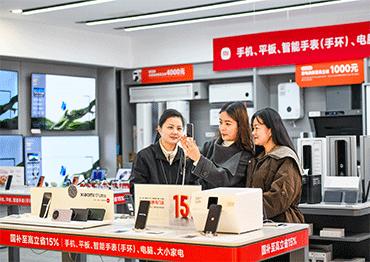
Customers browse a selection of subsidized mobile phones at a Xiaomi store in Huanggang, Hubei Province, March 6, 2026 (Photo by VCG)

A woman surnamed Wang in Henan Province thought she was getting a bargain on a new air conditioning unit.  

Taking advantage of China's 2026 home appliance replacement subsidy scheme, which started on January 18 this year, she purchased a Hisense air conditioner, only to pay more than her father had for the exact same model 10 days earlier when there was no subsidy. 

When they discovered the discrepancy, the Wangs complained to local authorities and the media. With others reporting the same issues, the subsidy price gap has sparked public doubts over whether the program can truly pass on benefits to consumers as intended. 

Launched nationwide in 2024, trade-in subsidies for cars, home appliances and digital products are a core policy tool to stimulate domestic consumption and promote newer energy-efficient and eco-friendly products. The policy has expanded to cover a wider range of products since 2025. 

In 2026, the subsidy was set at 15 percent for home appliances, digital and smart products. Subsidies are calculated based on benchmark prices pre-registered by manufacturers, with 1,500-yuan (US$218) maximum caps for home appliance products, and 500 yuan (US$73) for digital and smart products priced under 6,000 yuan (US$870). 

Government data backs up the policy's stimulus effects. In 2025, the government allocated 300 billion yuan (US$44b) in super-long national debts to support the initiative, driving 2.61 trillion yuan (US$378.5b) in consumption of subsidized products. At a regular press briefing in late January 2026, Commerce Ministry spokesperson He Yongqian revealed that the government-backed consumer goods trade-in program has seen enterprises above a designated size (with annual revenue of US$2.9 million) reach double-digit year-on-year growth in retail sales of home appliances, furniture and office supplies. Retail sales of communication equipment rose by 20.9 percent. 

For 2026, the central government has allocated 250 billion yuan (US$36.7b) for retail subsidies. Data from the National Development and Reform Commission (NDRC) shows that by June 20, the amount of sales covered by trade-in programs has exceeded one trillion yuan (US$146.9b), benefiting around 136 million consumers. Every 1 yuan subsidy raises about 10 yuan in sales. 

Yet, despite the robust growth in consumption, consumer grievances have increased. Many have reported that the final subsidized prices for some products are higher than regular non-subsidized promotional prices. While retailers and manufacturers claim the lower pre-subsidy prices are due to exclusive commercial promotions and argue that subsidies are calculated according to registered benchmark prices rather than temporary discount rates, public calls for tighter supervision over subsidy fraud and falsified transaction records have been rising.

Down with Markups
According to the purchase invoice Wang's father showed to NewsChina, he bought his Hisense air conditioner from Pangdonglai, a supermarket in Xuchang, Henan Province on January 8 for 2,190 yuan (US$318). Ten days later, his daughter purchased the identical model at the same store under the new State subsidy policy, for 2,201.5 yuan (US$320). 

The local government's subsidy policy started on January 12. Wang's invoice shows the product's price was marked up to 2,590 yuan (US$376). After deducting the 388.5 yuan (US$56) subsidy, the final price was still 11.5 yuan (US$1.7) higher than the non-subsidized price. 

"My daughter gained no benefits at all from the State subsidy," Wang's father said. 

Wang complained to Pangdonglai, whose customer service told her that merchants may cancel manufacturer-exclusive promotional discounts ahead of the launch of State subsidies. Hisense's customer service said they had never offered manufacturer-exclusive subsidies, and all retail pricing is determined by retailers. 

Pangdonglai later provided Wang with documentation confirming that it received an official price adjustment notice from Hisense on January 11 which said the air conditioner model should be sold at a minimum price of 2,590 yuan (US$376) with a recommended retail price of 2,790 yuan (US$405). 

In its public response, Pangdonglai clarified the pricing timeline. The model's factory guidance price was 2,690 yuan (US$390) from May 29 to August 3, 2025. In November 2025, Pangdonglai purchased 350 units at a special bulk preferential price of 2,190 yuan (US$318), and all discounted inventory was sold out by January 8, 2026. Given Hisense's 2026 price adjustment circular set a 2,790yuan (US$405) recommended retail price, Pangdonglai adjusted its sales price to the manufacturer-mandated minimum threshold of 2,590 yuan (US$376). 

Wang, who does not buy the explanation, insists that it is unreasonable for subsidized products to cost more than regular market-priced goods. The family turned to the media to make people and authorities aware of the issue.

‘Benchmark Price'
Wang is not alone. In February 2026, an unnamed consumer in Tianjin reported a similar irregularity to local media. The post-subsidy price of an iPhone he intended to purchase on an online platform rose from the pre-policy market price of 4,449 yuan (US$645) to 4,799 yuan (US$696). 

When he contacted customer services, they confirmed the product's official benchmark price was set at 5,599 yuan (US$812), and the 4,799 yuan was the standard discount price after deducting the State subsidy. The platform claimed such price fluctuations were normal market adjustments. 

The consumer reported the issue to local regulatory authorities, who responded that the previous low price might be based on high sales figures boosted by promotions, and attributed the price hike to the rising price of raw materials in the first quarter of 2026. 

"Most retailers will raise product prices before subsidy launches, as long as it doesn't exceed the government-filed benchmark price," Liang Zhenpeng, a home appliance industry analyst, told NewsChina. "The official benchmark price excludes all commercial discounts and promotional concessions," he said. 

"The government offers a 15 percent discount based on manufacturers' registered benchmark prices. Yet in non-subsidy periods, retailers often launch promotions and price cuts to compete for market share, which may cause regular selling prices to become lower than the subsidized prices," he added.

Profit Pressure
According to Liang, pre-subsidy price hikes are primarily driven by shrinking profit margins amid a saturated home appliance market and soaring raw material costs. 

At a press conference in February 2024, Ministry of Commerce spokesperson He Yadong said that Chinese consumers are now showing demand for both new and refurbished home appliances. In 2023, Chinese households had more than three billion major home appliances, indicating huge market potential for product renewal and replacement. 

Industry data from All View Cloud, a Chinese home appliance market analyst, showed that in 2024, China's installed stock of home appliances reached four billion units. It observed that before the State subsidy, home appliance manufacturers were trapped in price wars, which undermined their willingness to innovate and upgrade their products. The subsidy policy has stimulated consumption and given impetus to manufacturers to launch better products. Although the price of most of home appliances has risen with market demand, manufacturers still worry that the subsidy program will absorb enormous demand for new products in advance, which will probably collapse once the subsidies end. 

"Whether subsidized prices deliver real benefits varies by product," Tan Tao (pseudonym), a Wuhan-based home appliance retailer who has participated in the subsidy program for three years, told NewsChina. He believes that price adjustments are essentially profit-protection measures for merchants. 

"The subsidy application process may increase merchants' operating costs, including higher taxable invoice bases and additional labor and procedural expenses," Tan said. "Raising prices is a reliable way for retailers to cover the cost. No merchant is willing to operate at a loss by offering additional discounts on top of subsidy benefits." 

Liang points out that prices are increasing anyway due to the much higher cost of raw materials, such as copper, aluminum, iron and plastic. 

Data from the China Non-Ferrous Metals Industry Association shows that in the first quarter of 2026, the price of 10 commonly used non-ferrous metals rose sharply year-on-year. Copper was up 30.5 percent, aluminum 17.3 percent, tin up 48.6 percent, cobalt up 135 percent and lithium chlorate up 98.9 percent. 

"When setting registered benchmark prices for subsidized products, manufacturers prioritize cost recovery and profit stability," Liang said.

Fake Transactions
Post-subsidy price inflation has triggered widespread consumer dissatisfaction and undermined public trust in national pro-consumption policies. On Black Cat, a leading consumer complaint platform under Sina China, there were more than 30,000 complaints about subsidy-related price irregularities. 

At a year-end press conference in late 2025, a spokesperson from the National Development and Reform Commission (NDRC), China's top economic planner, acknowledged prominent problems in the subsidy program's implementation, including inadequate policy execution, arbitrary price hikes and fraud. 

Before that, official audits of 2024 fiscal budgets across 26 provincial-level regions revealed subsidy irregularities and illegal fund utilization in six provinces and municipalities, with the total amount of fraudulent money across the six areas exceeding 100 million yuan (US$14.5m). 

An anonymous home appliance industry insider told NewsChina that blatant overpricing above registered benchmarks has become rare due to regulatory oversight. Instead, industry players have ways to conceal their manipulation, such as registering identical products under new model codes to apply for higher benchmark prices. 

"Arbitrary price hikes are not the most severe violation," Xu Yingchao, director of the New Crime Defense and Research Department at Jiangsu Guosong Law Firm in Nanjing, Jiangsu Province, told NewsChina. "Some retailers and manufacturers have allegedly faked transactions to siphon off State subsidies, which may constitute a criminal offense." 

As seen in provincial audit results, local authorities have referred some serious subsidy fraud cases to judicial agencies for criminal investigation. 

The government of Yinjiang Tujia and Miao Autonomous County in Guizhou Province revealed a case where a seller surnamed Wang allegedly stole ID information to fake transaction records, defrauding over 30,000 yuan (US$4,350) from the scheme. The court ruled that Wang was guilty of fraud. He was given a suspended six-month sentence and a fine of 6,000 yuan (US$884). 

According to Xu, criminal subsidy fraud has increased rapidly. "Two years ago, only around 10 cases were recorded annually, but lately there've been around three to four new cases almost every month," he said. 

"There's an urgent need for improved supervision systems and stricter transaction reviews," he added, calling for more rigorous verification of consumer identity information and transaction credentials to block fraudulent subsidy claims. 

Some local authorities have rolled out targeted regulatory measures to plug loopholes. Several provinces such as Shandong have established a dual supervision mechanism combining municipal-level preliminary review and provincial-level inspections, in which prices are checked over several months, as well as orders, transactions and stocks. Others have adopted intelligent supervision tools, such as building digital monitoring platforms, to monitor and trace the whole transaction process of subsidized products. 

To standardize pricing behaviors, central authorities launched a unified benchmark price database for all subsidized products, which references merchants' sales records over the previous six months. A standardized punishment mechanism has also been implemented so vendors with three verified violations will be disqualified from the subsidy program and subject to fines. 

In a 2026 document on the subsidy scheme, the NDRC pledged to expand the coverage of the subsidy program and conduct a strict crackdown on fraud and price hikes before subsidies. 

NDRC spokesperson Li Chao reiterated the commitment at a press conference on June 24. Official data shows that from January to May this year, retail sales of high-efficiency home appliances manufactured by above-designated-size enterprises surged by over 30 percent. The market penetration rate of new energy vehicles in retail sales has exceeded 60 percent for two consecutive months and retail sales of wearable smart devices, newly covered by subsidy policies this year, have doubled year-on-year.
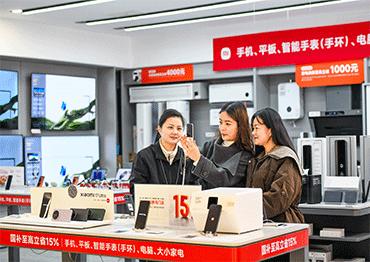

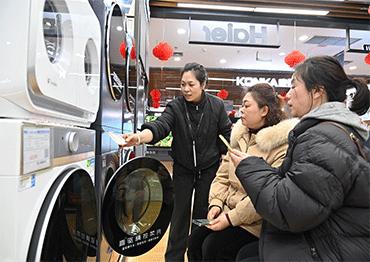
A saleswoman shows subsidized washing machines to customers at a department store in Chongqing, February 7, 2026 (Photo by VCG)

Print