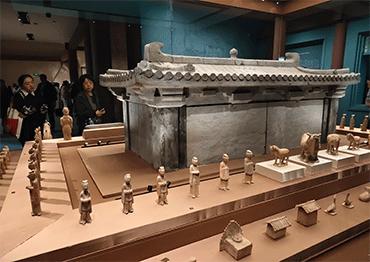
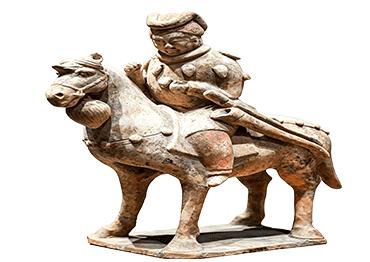
The National Museum of China is transporting visitors back more than 1,400 years with "Discoveries at Li Jingxun's Tomb - A Glimpse into 6th- 7th Century China."
The exhibition, which began in April and lasts until October 8, draws on burial artifacts and historical documents discovered from the tomb of a young girl from the Sui Dynasty (581-618), which reunified China after nearly 300 years of division and laid the foundations for the subsequent flourishing of the Tang Dynasty (618-907).
The exhibited treasures, including gold and silver ware, jade artifacts, glassware, silk textiles and exquisite jewelry that blend Persian and Central Asian artistry, offer far more than a glimpse into the poignant life story of a child.
They open a unique window into the broader cultural landscape of 6th-7th century China, a cosmopolitan age when the Silk Road brought Persian gold and silver, Indian jewelry and Central Asian craftsmen to the heart of the Middle Kingdom.
In 1957, while conducting archaeological excavations to accommodate construction to the west of Xi'an, Northwest China's Shaanxi Province, archaeologists discovered a well-preserved Sui tomb.
Having never been looted, its clear structural layout and abundant items remained intact, making it the highest-ranking and best quality Sui tomb discovered to date.
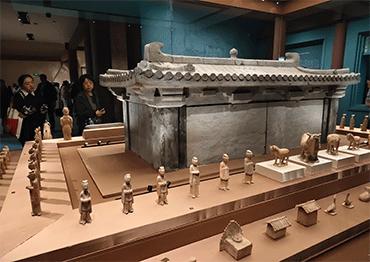
Oriented north to south, the tomb passage extends into a burial chamber, where an outer stone coffin sits in its center. Inside rests a palace-shaped inner stone coffin. The structure is laid out with an order and precision that reflects the Sui ritual system.
Even senior archaeologists were awed by the sheer richness and splendor of the tomb's items. But nothing prepared them for the hair-raising characters carved onto the inner stone coffin: "Whoever opens this shall die."
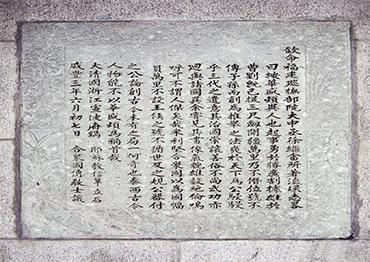
According to the epitaph, the tomb belonged to Li Jingxun, whose courtesy name Xiaohai, means "little one." She was born in the year 600 and died in 608. The very name "little one" speaks to how cherished she was.
Li Jingxun was born with a silver spoon in her mouth. Her lineage extended across the Northern Zhou (557- 581) and Sui dynasties, positioning her family at the heart of the Guanlong Military Aristocracy, a marriage-based, multi-ethnic group of warrior elites. Deeply rooted in Northwest China, the group held sway over the region while China remained splintered between rival northern and southern powers.
As a direct heir to this legacy, Li Jingxun's bloodlines were intimately woven into the imperial houses of both the Northern Zhou and Sui dynasties. Her paternal great-grandfather was Li Xian, a grand general of cavalry for the Northern Zhou. Her maternal grandfather was Yuwen Yun, Emperor Xuan of the Northern Zhou. Her maternal grandmother, Yang Lihua, was not only an empress of the Northern Zhou but also the eldest daughter of Yang Jian, otherwise known as founding Emperor Wen of the Sui.
The Li, Yuwen and Yang families, all converging in this one young girl, drove the wheels of history forward during the tumultuous transition from the Northern Zhou to Sui.
The chilling characters carved on the stone coffin, "Whoever opens it shall die," are at once a curse against tomb raiders and an everlasting protection, embodying the most eternal determination of a grandmother for her young granddaughter taken too soon.
That grandmother was Yang Lihua, born in 561, who raised Li Jingxun personally, bestowing upon this granddaughter all the tenderness she had never been able to give her own daughter or herself. Apart from the curse, the epitaph on the tomb reads that Li Jingxun was cherished and tenderly raised solely by her grandmother Yang Lihua.
The epitaph offers no glimpse into Li Jingxun's childhood days, yet from the sheer opulence of her tomb and its curse, we can piece together a vivid picture: She wore the finest silks, was adorned with the rarest jewels, and spent eight years sheltered beneath her grandmother's loving wings. Some modern writers have described her as the "most spoiled child in history."
Throughout her life, Yang Lihua found herself trapped in a relentless power struggle. Her father, Yang Jian, was a senior minister in the Northern Zhou Dynasty. From a young age, Yang Lihua was renowned for her beauty, noble bearing and gentle disposition. At 13 years old, she was selected as crown princess to crown prince Yuwen Yun. Five years later, Yuwen Yun ascended the throne as Emperor Xuan, and Yang Lihua was named Empress Tianyuan. Their daughter Princess Yuwen Eying, born at an unknown date, was the mother of Li Jingxun.
Two years later in 580, Emperor Xuan died of illness, and 20-year-old Yang Lihua was honored as empress dowager. To ensure political stability, she appointed her father Yang Jian as grand counselor and commander of all military affairs, effectively placing the military and political power of the Northern Zhou in his hands. Yet only seven months later, her father initiated a move that thrust her into an impossible position. Yang Jian deposed the Northern Zhou emperor, proclaimed himself emperor and changed the dynasty's name to Sui.
After the fall of the Northern Zhou, Yang Lihua became Princess Leping of the Sui. As a woman who had been an empress of the Northern Zhou, she was now the daughter of the man who had destroyed her adopted dynasty. Torn between her birth family and her marital family, she endured a lifetime of unresolved conflict.
As the only figure from the former dynasty to remain active within the Sui imperial family, Yang Lihua still held a certain influence over the Northern Zhou's former subjects. But she stayed away from court politics and isolated herself from any political alliance. Her only solace was perhaps her daughter and her granddaughter.
Yang Lihua's love for Li Jingxun was more than a grandmother's devotion. It was a quiet act of self-redemption. She had never truly lived. So she poured into Li Jingxun everything life had denied her.
However, in 608, a sudden illness claimed Li Jingxun's life. That glimmer of light was extinguished. All of Yang Lihua's obsession was transformed into opulent burial rituals and protective curses. She would use every means possible to keep her "little one" close and safeguard her forever.
One year later, Yang Lihua accompanied her younger brother, Emperor Yang of the Sui on a western inspection tour. By June, they had reached Zhangye, in modern-day Gansu Province, where Yang Lihua passed away at the age of 49.
According to the ritual system of the Sui Dynasty, underage children could not be interred in a family's ancestral cemetery or accompanied by lavish grave goods. However, Yang Lihua was determined to give her little girl a dignified final resting place. She chose a burial site within Wanshan Nunnery in the Sui capital and had a magnificent multi-story Buddhist pagoda built over the tomb.
Wanshan Nunnery was once Yang Lihua's own residence, making it a place of profound personal connection. By choosing this nunnery as her granddaughter's final resting place, the grandmother ensured the child would remain perpetually by her side, where she could offer protection and solace.
Li Jingxun's tomb followed the full ritual standards of an adult noblewoman. The number and exquisite quality of the burial goods surpassed those found in many tombs of adult Sui Dynasty aristocrats. The more than 230 extraordinarily luxurious objects include gold and silver ware, jade artifacts, ceramics, glassware, silk textiles and jewelry, each a masterpiece of Sui Dynasty craftsmanship.
In the exhibition at the National Museum of China, a gold hairpin is at the center. It features a lotus-leaf-shaped base made of rolled gold sheets, on which stands a moth woven from fine gold wire. The eyes of the moth are inlaid with pearls, its antennae are made of gold wire, and its hollow body could possibly hold incense. Beneath the moth cluster a six-petal gold flower and triangular gold leaves. The flower stamens are set with pearls and gemstones. As the wearer walks, the ornament gently quivers. In ancient times, wearing such hair ornaments was an important custom during the Lantern Festival, which marks the end of Chinese New Year.
Another highlight is a gold necklace inlaid with pearls and gems, measuring 43 centimeters in length and weighing 91.25 grams. The top of the necklace is adorned by a deep blue lapis lazuli with an intaglio-carved horned deer. At the lower end, 24 pearls surround a single chicken-blood stone, and beneath it hangs a heart-shaped sapphire measuring 3.1 centimeters in length. The gold necklace blends Persian and Central Asian artistic styles. Its techniques, patterns and materials can all be traced back to regions such as Afghanistan or Pakistan. It is likely that the necklace was an imported object brought to China via the Silk Road, or made by a Sogdian craftsman living in China. Alongside the gold necklace, a pair of gold bracelets was unearthed. The bracelets are oval-shaped and divided into four sections, each section wider at the ends and inlaid with gems. This type of gold bracelet is unparalleled in ancient Chinese history, with its design likely originating in Northern India.
Glass used to be one of the most exquisite and expensive materials. Before the Sui Dynasty, glassware originating from Sassanian Persia had flowed into China. Archaeologists discovered eight glass artifacts and some glass beads in Li Jingxun's tomb, including a green glass jar with a lid and a small green glass bottle.
These burial artifacts ensure that Li Jingxun could still enjoy a refined and happy life in another world. Although she only lived eight years, a fleeting breath in the long march of dynasties, she managed to cross time through her grandmother's love.
 Old Version