Old Version
Life

Farm to Timetable

A new shuttle bus route in mountainous Guizhou is helping farmers transport fresh vegetables to the city, cutting time and costs while reshaping lives along the way

By Wu Jin Updated Jul.1

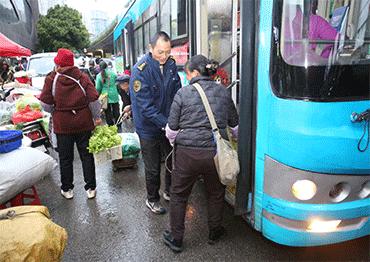
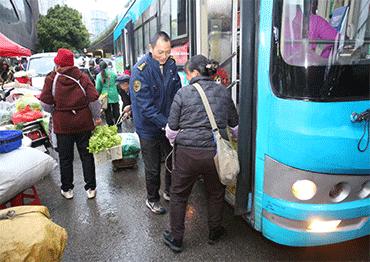
A Route 252 bus driver helps a farmer carry her vegetables onto the bus, Guiyang, Guizhou Province

One early April dawn, around 5 am, the sky had yet to brighten. Villagers carrying fresh vegetables from Guiyang, the capital of Guizhou Province, hurried toward the Route 252 bus, its lights slightly illuminating the surrounding mountains.

American influencer Jackson Hinkle, who has approximately 3.8 million followers on X, boarded the bus along with the rural passengers. 

"Right behind me is a giant bus filled with farmers who are taking their goods, their agricultural products, to the capital city to sell," Hinkle said in a video released in early April on YouTube and Chinese short video platform Bilibili, which has reached over 900,000 combined views. 

The video shows how a bus route connecting rural and urban areas has helped farmers sell their freshly picked vegetables to urban residents. Hinkle added that the initiative was made possible by a local government poverty alleviation program. 

Since the launch of the bus in June 2024, shuttles are estimated to have carried 11,000 farmers and more than 1,000 tons of vegetables across 552 trips by March 10, 2026, according to a Guizhou Legal News report on April 13. 

The route has attracted wider attention, including from Taiwan singer and actor Kenji Wu, who also took the bus and helped auction local farmers' produce in early February. 

The success of the program has expanded to benefit more farmers. Guiyang has now scheduled 40 special rural shuttles, transporting around 1,400 tons of agricultural products for about 300,000 farmers, according to the Partyrun People's Daily on April 15.

Country Routes
Wrinkled and sun-tanned, an elderly villager sharing the bus with Hinkle told him that before the dedicated route was launched, locals had to leave home two hours earlier. 

"If we didn't have this bus, I wouldn't be able to go to the market anymore," she said. 

It is common in China for farmers to sell surplus vegetables to urban residents for extra income. However, in mountainous Guizhou Province, that often means traveling up to 20 kilometers one way. 

Villagers who wanted to sell their homegrown vegetables in the city previously had three choices: trudge along mountainous roads, hitch rides or pay up to 40 yuan (US$5.85) for a one-way bus trip with multiple transfers. Sometimes their 50-kilogram vegetable parcels, for which they had to pay extra, took up too much space, causing friction with other passengers. 

"Before, we had to take the regular public bus, which starts at 7 am, but it gets here past 8, sometimes even 10, because it makes far too many stops," a middle-aged farmer told Hinkle while selling vegetables in Guiyang. 

When Wang Xinxin, a 37-year-old deputy to the People's Congress of Guiyang's Wudang District, learned about the farmers' difficulties during an onsite inspection in the town of Xiaba, she forwarded the issue to Guiyang's transportation commission and municipal transportation bureau. 

In response, provincial public transport authorities planned with Xiaba's local government to start a special bus route with a fare cap of 7 yuan (US$1). However, rural scheduled bus owners under contract with State-owned public transport companies initially refused to extend bus routes into rural areas. 

Wang spent a week filming the long trips farmers took to reach urban areas, which eventually persuaded the bus operators. 

On June 1, 2024, the first Route 252 bus, designed specifically for farmers, hit the road. Stops were reduced from more than 30 to five, concentrated in farming-intensive areas. Commute time for a one-way trip was shortened from 80 to 60 minutes, according to Luo Song, director of market operations with the provincial transport authority, who spoke to Guizhou Legal News in April. 

The dedicated bus route has cut travel expenses by 900 yuan (US$132) per month for farmers like 57-year-old Song Peibi, Luo said. 

"The bus route has brought rural and urban areas of Guiyang closer. It also shows that Guiyang is a very welcoming city. Everyone is invited to take Route 252 and feel the breath of spring," a bus driver told Hinkle in an interview.

More on Board
"When there's just the slightest bit of, you know, intention put into planning, these Five-Year Plans that China actually adopts and implements and closely monitors and evaluates to make sure that they are fully implemented and actually ahead of schedule, you can change millions of lives within a very short period of time. And that's what we are seeing here today," Hinkle said in his video. 

Two weeks after the video was posted on YouTube in early May, it had over 160,000 views and 11,000 likes. 

"Noticed they didn't give the villagers free money but help them to make money," wrote YouTube user "KMuse99." 

In early February, 47-year-old Kenji Wu also took the bus. 

In 2018, after his mother passed away and he experienced career setbacks after a failed film project, Wu began shooting videos in rural China. Among his trips to the countryside, the journey on Route 252 impressed him the most. 

"It was while helping lift the heavy sacks of vegetables while getting on the bus with local farmers that I realized what weighty hope really means," Wu wrote in his article "Behind Online Traffic: Trust and Responsibility," published in the People's Daily on April 9. "Lives on the ground, rather than in recording studios, inspire creativity." 

Immediately after the trip, Wu invited about 50 restaurant and supermarket operators to an auction in Guding Village, Guiyang to help sell vegetables. More than 15,000 kilograms of produce were sold through these efforts. 

"Online traffic is genuine when it touches the soul," he told State-run media outlet CGTN on February 7, following the auction.

Pop singer Kenji Wu helps farmers sell vegetables at an auction in a village in Guiyang, Guizhou Province, February 4, 2026 (Photo by VCG)

Print