Old Version
Cover Story

Staying Power

As enterprises are ordered to retire small coal-fired plants they built themselves in industrial heartlands, green energy is becoming a bigger part of the mix. Yet experts caution that authorities should pay attention to costs and heat supply, as well as cutting emissions

By Chen Weishan and Xie Ying Updated Nov.1

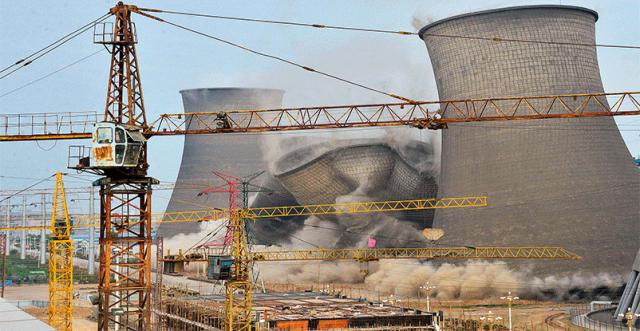
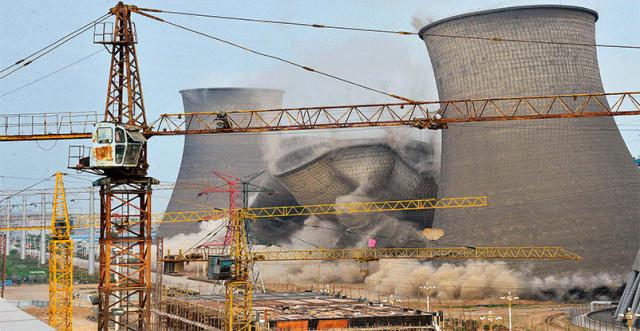
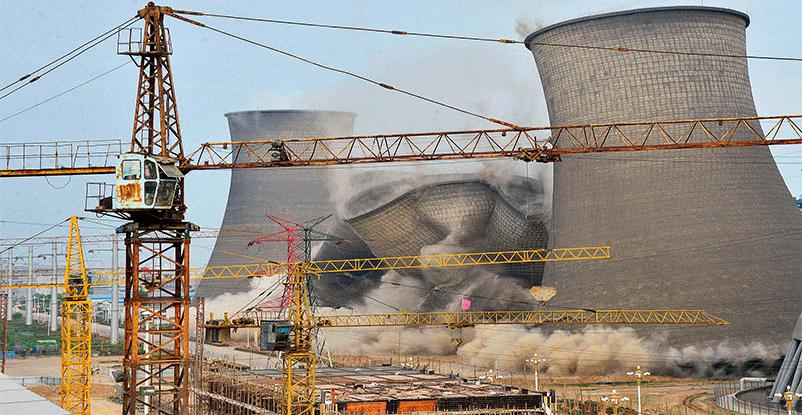
Three cooling towers at a coal-fired power plant owned by Shandong Xinfa Group are demolished, April 26, 2016. (Photo by CNS)

Shandong Province, one of China's leading industrial heartlands, retired 555 small coal-fired generators of under 300 megawatts (MW) between 2021 and 2025, removing a combined capacity of 17.5 gigawatts (GW), according to the provincial energy bureau in June. 

Most of the units exceeded the 2025 national threshold for new coal-fired projects, 300 grams of standard coal consumption per kilowatt hour (kWh), bringing the average consumption down from 308g of standard coal in 2020 to under 295g. 

Many of these extraction-condensing units, which generate both electricity and steam for heating, were built and operated by energy-intensive industrial enterprises to lower power costs and ensure stable supply. Notably, State-owned enterprise (SOE) Shandong Longsheng Iron and Steel retired three 25 GW units it had built at its plant in Zibo. 

The eastern coastal province is one of China's most populous, and in terms of industrial output, ranks third-highest in crude steel production and first in aluminum production, according to government data. Many Shandong enterprises constructed and operated their own coal-fired plants, most with a capacity of below 300 MW. These small less-efficient units once accounted for 80 percent of the province's total installed coal-fired stations before the shutdown campaign, with an average installed capacity per unit of only 118 MW. 

In the first half of 2026, coal-fired power generation declined to below 50 percent of the country's power supply for the first time, according to the National Energy Administration. At the end of 2023, total installed capacity of renewable energy accounted for more than half of China's total energy capacity. 

To advance China's net-zero goals, the country has tightened control of small coal power plants since 2007, as they create more pollution and are less efficient than bigger ones. In 2013, control of self-built coal-fired generators began to be prioritized. The Air Pollution Prevention and Control Action Plan released that year banned new self-built coal-fired power stations for industrial projects in the Beijing-Tianjin-Hebei, Yangtze River Delta and Pearl River Delta regions.
 
A 2021 central government document stipulated that no new self-built coal-fired power units be approved and encouraged existing coal-fired units to be replaced by clean energy facilities or transferred to public use, usually used to supply heat for neighborhoods or regulate electric supply during periods of green energy peaks and troughs. This ensures stable supply while maximizing green energy use. 

However, as the Shandong case shows, the issue involves more than merely closing down inefficient and polluting power plants.

Big Emitters
There is no accurate data on how many self-built fossil power plants China has now, but 2015 data from the National Development and Reform Commission (NDRC) showed that in 2014, self-built coal-fired power plants had a total installed capacity of more than 110 GW, accounting for 8 percent of the country's total. They concentrated in resource-abundant regions and those with carbon-intensive industries. 

While coal-fired capacity is declining, it is still a major source of carbon emissions. An expert who studies how coal-fired units are retired told NewsChina on condition of anonymity that average coal consumption of small extraction-condensing units is around 60g higher per kWh than that of a standard 1 GW unit. Some old units consume 400g per kWh. 

In 2021, Shandong consumed a total of 394 million tons of coal, and coal used for power generation accounted for 58.5 percent of total provincial coal consumption, according to China Energy News. Meanwhile, coal-fired power industries accounted for 41 percent of the province's total carbon emission, with small-capacity coal-fired units making up 47 percent of the whole industry's total carbon emissions. 

"Most coal-fired power plants under 300 MW in Shandong have either been shut down or transferred into public use, but few of those above the capacity threshold, mostly built and operated independently to support heavy industrial conglomerates, were included in the shutdown for transferring-to-public use policy," Liu Bo, president of Shandong Thermal Power Design Institute, told NewsChina. 

"Transferring to public use is usually driven by policies or consultation with the authorities, but it isn't easy, no matter where you are in the country," he said.

Cost and Control
Heavy reliance on carbon-intensive industries is why Shandong has difficulty regulating self-built coal power plants. Using the electrolytic aluminum industry as an example, Liu Xiaolei, senior aluminum analyst at SMM Information & Technology, told NewsChina that producing one ton of electrolytic aluminum consumes around 13,000 to 14,000 kWh of power, which is why enterprises rely on their own generating plants. 

According to 2023 data from the Ministry of Ecology and Environment, the electrolytic aluminum sector consumed over 500 billion kWh of electricity annually, accounting for 6.8 percent of China's total electricity use, and more than 60 percent of domestic electrolytic aluminum production depended on self-built coal plants, resulting in their products' carbon intensity being vastly higher than their international competitors that use renewables. 

"In 2018 and 2019, electrolytic aluminum's reliance on self-built power plants rose to 75 percent. Even last year, it was still 55 percent," Liu Xiaolei said. 

Zhang Shiping, founder of Shandong Weiqiao Pioneering Group, a Shandong-based private conglomerate engaged in textiles, apparel, home textiles, thermal power, aluminum and salt chemical industries, told media that he was forced to build his own power plants, due to high prices and the monopoly of State electricity supply, which was often affected by power outages. 

With official permission, Weiqiao Group built its first power plant in 1999, whose installed capacity later expanded to 1 GW, enough to power roughly 750,000 homes. Without the same onus as public power plants to provide subsidized electricity for residents and rural areas, self-built power plants at that time lowered the cost of electricity to 0.206 yuan (US$0.03) per kWh, less than that of the State grid and 35 percent lower than the average industry price. It meant every ton of electrolytic aluminum produced had a savings of around 2,700 yuan (US$386). 

"It was a common industry practice to build their own power plants in regions where electricity was cheaper. In the past, many enterprises tended to build plants in coal-abundant areas like Xinjiang and Inner Mongolia autonomous regions, where the price of electricity was only 0.1-0.2 yuan (US$0.014- 0.028) per kWh," Liu told NewsChina. 

Liu Xiaolei described the rush by electricity-hungry industries to build power plants after 2010 as a "craze." In December 2017, central government environmental protection supervisors warned that self-built power plants in Shandong saw explosive growth. Despite the ban on new coal-fired power units, since 2013, Weiqiao Group has illegally built 45 power units in its headquarters in Binzhou, while local authorities did nothing. Meanwhile, Xinfa Group in Liaocheng, which engages in power generation, heat supply and deep processing of aluminum, illegally built nine coal-fired units. 

When Shandong authorities launched an investigation, they found that since 2013, 110 coal-fired power units were illegally built by enterprises in the province with a combined installed capacity of over 26 GW. 

The building craze directly led to a huge increase in coal consumption, according to the report by the central government's environment investigation team in December 2017. In 2016, Binzhou and Liaocheng consumed 48.92 million and 10.57 million more tons of coal than in 2012. 

In March 2018, the NDRC issued its strictest program to control self-built power plants and Weiqiao's and Xinfa's illegal units were listed in the provincial program. Impacted by the closures, Weiqiao's 2018 revenue dropped by 20 percent year-on-year and profits dropped by nearly 34 percent, media reported. 

Since the end of 2017, the government has no longer approved new electrolytic aluminum plants, Liu Xiaolei said. However, existing enterprises are still expanding production capacity, from 40 million tons annually to 45 million which has caused electricity use to increase. But pressured by the ban on self-built power plants, the industry has been trying hard to find new sources of power supply since 2018, he said. In 2018 and 2019, many enterprises, including Weiqiao, moved aluminum smelters to Southwest China's Yunnan Province, where hydropower is the main energy source. 

According to government regulations, if a coal-fired power unit reaches the emissions threshold of 26,000 tons of CO2 equivalent, it is subject to the same strict management as State power plants. Self-built power plants made up a large proportion of the first 2,162 major emitters listed in the compulsory national carbon market. These plants are obliged to submit emissions plans for approval, and have to buy credits from other operators if their final emissions exceed the quota. 

In 2025, the electrolytic aluminum industry was ordered to consume green electricity at a rate of at least 25 percent, driving many enterprises to buy more green electricity from the public grid. 
In October the same year, Lin Yifan, president of the State Grid Shandong branch, held a meeting with Zhang Bo, president of Weiqiao, after which the conglomerate integrated its own power units into the national grid, meaning it was no longer independent in power generation. 

Weiqiao is thought to have made this choice to balance electricity costs and pressure from the government's carbon targets. 

"Compared to self-generated power, electricity from the public grid is sold for 0.1 yuan (US$0.014) more per kWh, which means a 1,300 yuan (US$186) increase per ton of production. But as the government has banned new electrolytic aluminum capacity building since 2018, enterprises instead benefit from decreased supply, earning a profit of about 4,000-5,000 yuan (US$570- 715) per ton, and even 6,000-7,000 yuan (US$860-1,000) per ton in the first half of this year. It has enabled them to offset the cost increase in electricity," Liu Xiaolei said. Profits are up without the need to produce more. 

But he warned that industrial enterprises are very concerned about sunk costs, since most self-built coal-fired power plants have a 30-year lifespan and operators can better control their operating costs. 

Wu Di, a researcher at the Peking University Institute of Energy Research, agrees. "For carbon-intensive industries like electrolytic aluminum, petrochemicals and iron and steel, the cost of electricity and steam directly relates to the competitiveness of their products, and self-built power plants are actually an internal source of power supply. Amid increasing electricity price fluctuations, the rising cost of operations and the entry of new energies, enterprises care more about the controllability and stability of the cost of energy use," he said. 

"Regulators demand [these plants] to be retired, but industrial operators may not be able to afford to do it," he added.

More Ways Out
Affordability is not just an issue for enterprises but also the whole province. Although new energy like wind and solar has surpassed coal in installed capacity, electricity generation is still much lower than coal-fired power generation. Official data showed that in 2025, Shandong's installed capacity from wind and solar reached over 125 GW, exceeding 50 percent of the province's total installed power capacity, but the electricity generated from non-fossil energy supplied only 32.3 percent of the total, with the rest mostly coming from coal. 

Experts attribute it to Shandong's uneven distribution of new energy and limitations in use efficiency and power storage. To ensure a stable supply of electricity, Shandong had to depend on coal-fired units for load adjustment and smaller units are more flexible than big ones. 

Notably, Shandong's coal-fired units are heavily related to industrial and residential heat supply. 
"Shandong's heat supply and demand is pretty well balanced, but unlike electricity, which can be transported over long distances, industrial steam's most economical transport radius is 5-10 kilometers," Liu Bo said. 

Some 80 percent of Shandong's industrial heat supply relies on small coal-fired units with a capacity of under 300 MW, which are mostly located near enterprises, unlike larger units. "After some of these units are decommissioned, certain regions might face a shortage of heat sources or suffer a decline in the cost-effectiveness of industrial heat supply," Liu Bo said. 

Furthermore, some self-built plants, like those owned by Weiqiao, supplied cheap power and heat to neighboring residents. According to the China Energy News report, small-capacity units in Shandong used to provide 68 percent of civil heat. 

In 2023, Shandong had to restart some closed down small coal-fired units to guarantee heat supply, media reported. 

Wu said the approach must be more nuanced when choosing when and where to retire small plants. "It should vary with enterprises, industrial parks and techniques. We can't adopt just any one-size-fits-all approach," Wu noted. 

"For example, some units with relatively high efficiency that supports both regional power and heating systems can be converted to public use or transformed into regional integrated energy platforms. Their functional positioning should gradually shift from use entirely by enterprises toward public supply adjustment, coordinated power-heat supply, emergency backup and comprehensive energy services," he said. 

"However, small, low-efficiency units that don't have any public function like heat supply or those that operate in violation of laws and regulations, lack formal approvals or fail to meet emissions requirements should be ordered to be rectified, shut down or phased out based on a clear schedule," he added. 

Shandong government is exploring alternatives. In June 2026, Shandong brought online the Guohua Investment Shandong HG14 Offshore Project, a 1 GW marine solar installation 8 kilometers off the coast of Dongying. It is the largest offshore solar project in the world. In Zibo, it has improved cross-city heat supply by building relay stations and new networks. 


In May 2025, the NDRC and the National Energy Administration released a document encouraging industrial enterprises to connect to green power plants that can directly supply electricity without being integrated into the public grid. This allows enterprises to get cheaper green electricity. 

"This way suits industrial parks and regions where there is abundant new energy with stable loads," Wu said. "It's easier and more economical than industrial enterprises building green power plants themselves." 

At the 2024 China BlueSky Observation Forum held in December, He Kebin, director of the Institute for Carbon Neutrality at Tsinghua University in Beijing, stressed that the cost of cutting emissions will inevitably rise once emissions control enters a deeper and more difficult phase as pollutants beyond carbon are included in the scheme, and green transition and industrial upgrading have to be taken into consideration. 

"The core issue of retiring self-built coal-fired power plants is not simply to close or transfer them, but to answer the following practical questions: What could be their substitutes for heat and electricity supply and how can we ensure an affordable cost for the transformation?" Wu Di said.

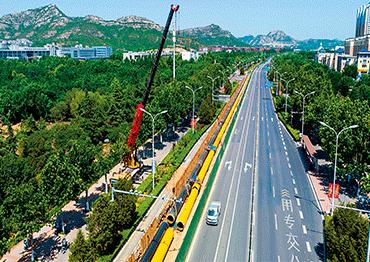
Construction is underway for a heat transmission project from Liaocheng to Jinan, Shandong Province, 2025. The project, which began construction in March 2025 and went into operation in December the same year, aims to make full use of the residual heat generated in Liaocheng (Photo Courtesy of the interviewee)

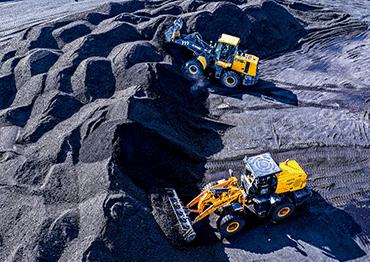
Two bulldozers move coal piles at a coal-fred plant in Rongcheng, Shandong Province, October 2025 (Photo by Xinhua)

Print