Old Version
History

Glaze of Glory

UNESCO has honored the world’s first porcelain-centered industrial heritage site, keeping the fires of tradition alive that continue to shape new stories for the world

By Lü Weitao Updated Nov.1

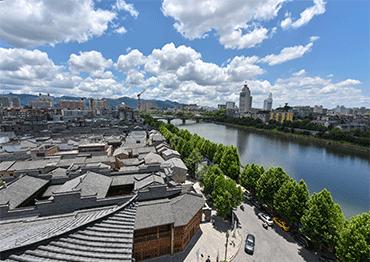
An overview of Jingdezhen Handicraft Porcelain Industry site, which is listed as a UNESCO World Heritage Site, Taoyangli, Jingdezhen, Jiangxi Province, May 29, 2025 (Photo by VCG)

In late July, UNESCO added Jingdezhen's porcelain industry sites to the World Heritage List during its annual committee meeting in Busan, South Korea, bringing China's total World Heritage Sites to 61. 

The inclusion marks China's first nomination of an industrial heritage site for World Heritage status and the world's first World Heritage Site centered on porcelain. 

Located in East China's Jiangxi Province, Jingdezhen is renowned for a porcelain-making tradition more than 1,700 years old. Abundant deposits of porcelain clay, combined with a well-developed water transport network, helped turn the city into the world's leading center of porcelain production. 

Spread across Jingdezhen's hilly terrain, the complex preserves a complete handcrafted porcelain production system that flourished from the 10th to the 19th centuries. Porcelain made in Jingdezhen traveled along the Silk Road to destinations around the world, literal vessels for cultural and commercial exchange between East and West. 

According to the World Heritage Committee, the sites demonstrate the development of Chinese ceramics, artistic traditions and the porcelain industry. It reflects the influence of China's traditional porcelain handicrafts on ceramic production worldwide, as well as global exchanges and mutual learning. 

The complex comprises 45 individual sites covering 1,979 hectares, including the town's production center, kilns, quarries, firewood forests and transport networks. Together, they create a complete picture of China's ancient porcelain industry.

Fired Up
Archeological excavations at sites in the town's center tell the evolution of the Imperial Kiln Factory, which made pieces exclusively for China's royal family from the late 14th century to the early 20th century. They also trace the development of privately operated kilns that served the broader market from the 12th century to today. 

Luomaqiao Site preserves kiln technologies, including gourd kilns and eggshaped kilns, each named after their characteristic shape, which enabled better temperature regulation and shorter firing times. Along with surviving modern circular kilns, they illustrate the history of kiln development. 

Unearthed oil storage tanks and oil pipelines further preserve Jingdezhen's technological shift from traditional wood firing to new fuel sources. 

Guanyinge Kiln Site includes extensive remains of workshops dating to the late Ming Dynasty (1368-1644) that illustrate the expansion of Jingdezhen's private porcelain industry and the sophisticated division of labor that developed. 

At Hutian Kiln Site stands a partially preserved dragon kiln from the late Southern Song (1127-1279). A dragon kiln is a long, sloping kiln built along a hillside used to fire large quantities at once. Hutian Kiln stretches 19.2 meters from north to south, winding like a giant resting dragon. 

According to Wang Guangyao, a research fellow at the Palace Museum in Beijing, Hutian Kiln combined porcelain-making techniques from northern and southern China. Batches of bluish-white porcelain, renowned for being paper-thin, mirror-bright and resonant like chimes, were shipped across China and beyond. 

Dragon kilns were gradually replaced by gourd kilns during the Yuan Dynasty (1271-1368). With moderately sloped kiln beds and higher interior temperatures, gourd kilns gave craftsmen new possibilities such as underglaze-red porcelain, where designs painted in a copper-based pigment are covered with a clear glaze and fired. 

The fires of Jingdezhen's kilns continued thanks to abundant raw materials and fuel. 

Gaoling Village, about 40 kilometers north of Jingdezhen, contains large deposits of kaolin clay, which forms naturally from weathered granite. 

An ancient trail about seven kilometers long winds through the village's mountains. Miners once hauled washed raw clay along the trail to riverside docks, where it was transported to Jingdezhen's town center. 

Located about 30 kilometers from the city center, stands of Masson's pines covering the mountains of Lifang Village fueled Jingdezhen's porcelain industry for generations. The local saying "for every acre of kilns, five acres of forests are used for firewood" describes the enormous amount of timber required to keep the kilns burning. 

To maintain a sustainable supply, villagers spared mature pines to provide seeds and burned undergrowth to promote new growth. The wind carried pine seeds to bare mountain slopes, where they took root and grew into new stands of pine for kiln fuel. 

Alongside its trade guild buildings and transport networks, Jingdezhen's town center included specialized compounds for porcelain packing, fine metalwork and overglaze painting, a technique where artisans paint designs on pre-glazed porcelain and then fire them again.

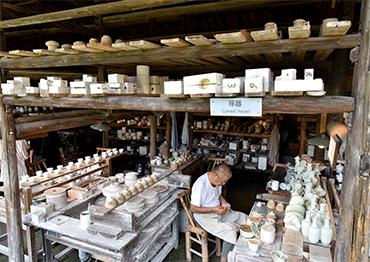
An artisan creates a porcelain piece at his workshop, Jingdezhen, Jiangxi Province, July 24, 2026 (Photo by VCG)

New Arrivals
Xiao Li, deputy director of the World Cultural Heritage Department at the National Cultural Heritage Administration, told NewsChina that Jingdezhen seeks to preserve its antiquities with approaches that minimize intervention. 

The city has restored more than 20 archaeological sites, over 130 officially designated cultural heritage buildings and 56 historic structures. It has also preserved 108 historic quarters and more than 250 traditional alleyways. 

One of the ways Jingdezhen protects the heritage of China's porcelain capital is by preserving its original street layout and residential communities. Rather than being walled off from the public, its heritage sites remain lived in and organically evolving. 

The city's reputation is largely built on its unique ecosystem of ceramic production. Generations of artisans have made their home there, passing down sophisticated porcelain-making skills through apprenticeships and family traditions. 

Modern machinery and automation have been introduced into some stages of production. Firing no longer relies solely on traditional wood-fired kilns. Yet key processes such as wheel-throwing, which 

shapes clay on a rotating wheel, hand-painting and glazing still depend heavily on manual skills. 

Today, more than 100,000 people work in Jingdezhen's ceramic and related industries, accounting for nearly one-quarter of the city's population. Meanwhile, thousands of young ceramic artists, designers and entrepreneurs from across China and abroad have moved to Jingdezhen. Known as jingpiao, a term that means "Jingdezhen drifters," they rent workshops, create artworks and launch businesses, bringing contemporary creativity to its time-honored porcelain industry.

Kiln It
Historically, Jingdezhen porcelain was prized in international trade, particularly during the Age of Discovery, the period from roughly the 15th to the 17th centuries when European maritime exploration greatly expanded global trade. 

In June, an 18th-century merchant ship carrying a large cargo of Chinese porcelain was discovered about 600 meters below the Skagerrak Strait off southern Norway. Most of the porcelain recovered from the wreck is blue-and-white ware. The Ancient Ceramics Gene Bank, a database for ancient pottery shards launched in Jingdezhen in 2022, confirmed that the pieces originated in Jingdezhen. 

The National Museum of Korea in Seoul houses a fine collection of bluishwhite porcelain produced at Hutian Kiln during the Song Dynasty. Recovered from archaeological sites dating to Korea's Goryeo period (918-1392), the works are celebrated as masterpieces of exceptional craftsmanship. Topkapi Palace Museum in Istanbul, Türkiye and the National Museum of Iran in Tehran also house substantial collections of Yuan Dynasty blue-and-white porcelain, most of it produced in Jingdezhen. 

During the Ming Dynasty, Jingdezhen strengthened its commercial ties with overseas markets. Huge quantities of export porcelain were shipped abroad, with many pieces specially designed and fired to meet European tastes. 

Armorial ware is a classic example. Commissioned by European aristocratic families, these pieces featured coats of arms and other heraldic designs. Their patterns and shapes were carefully adapted to European aesthetic preferences. 

After the 16th century, Jingdezhen's exported porcelain influenced not only European markets but also the development of Japanese ceramics. Japan's Imari ware, which emerged in the late Ming Dynasty, widely adopted forms, decorative motifs and firing techniques associated with Jingdezhen porcelain. 

In the 18th century, after Europeans acquired the skills needed to manufacture porcelain, early products from ceramic centers including Meissen, Germany and Delft in the Netherlands absorbed elements of Jingdezhen blue-and-white porcelain in both technique and artistic style. 

This made Jingdezhen not only a major global center for porcelain trade but also a crucial source of ceramic techniques and artistic influences exchanged across cultures. 

Naturally, such exchanges were never one-sided. The evolution of Jingdezhen's porcelain industry changed through sustained interaction between cultures. 

Yuan Dynasty blue-and-white porcelain provides important evidence of exchanges between China and the Middle East. Samarra blue, the cobalt-based pigment used to decorate much of this style, largely came from the Middle East, its decorative motifs drawing heavily from Islamic artistic traditions. 

Qing Dynasty (1644-1911) artisans incorporated European techniques and influences such as cloisonné, in which metal wires form compartments filled with colored enamel reminiscent of stained glass, and famille rose porcelain, known for its richly colored overglaze decoration. 

Within Jingdezhen's historic quarter, ruins of the Tianhou Palace and the city's mosque offer examples of cross-cultural exchange. 

Tianhou palaces are temples dedicated to the sea goddess Mazu, a protector of sailors and fishers prominent in the folk religion of the Minnan people of Southeast China's Fujian Province. 

Jingdezhen's Tianhou Palace not only represents how important maritime transport was for the city's economy, but also the influx of Minnan to the region attracted by the porcelain trade. 

The palace was long believed to date to the reign of Qing Emperor Kangxi (1662- 1722). New archaeological findings, however, have traced its origins to the reign of Ming Emperor Wanli (1573-1620). 

This earlier date closely corresponds with the Longqing Opening, a Ming Dynasty policy that lifted long-standing maritime trade restrictions and officially allowed private Chinese merchants to trade overseas. It also coincided with the rise of the Manila Galleon Trade, a maritime network in which Spanish ships sailed between Manila in the Philippines and Acapulco, Mexico, exchanging Chinese porcelain, silk and other East Asian goods for American silver. 

Excavations at Jingdezhen Mosque ruins reveal its prior history as a workshop producing high-quality ceramics as early as the late Southern Song. 

Unearthed artifacts include Arab magic square porcelain, decorated with square motifs associated with the Islamic world, vassal kings' wares and porcelain produced under a system in which production was privately run under official oversight. 

Archaeologists interpret its conversion to a mosque during the reign of Qing Emperor Kangxi as evidence of the interplay between religious needs and commerce, as well as the growing influence of merchant guilds. 

This dialogue continues today. A series of academic conferences focused on Jingdezhen's porcelain heritage has brought archaeologists and heritage researchers from around the world to the city. 

Cross-cultural dialogue also lives in Jingdezhen's ancient alleys, which are home to thousands of ceramic creators from more than 60 countries pursuing their creative aspirations. 

Kiln smoke no longer billows over Jingdezhen as it once did, yet the fires still burn. Ancient kiln mounds, weathered quarries and old docks stand alongside bustling workshops, where local craftsmen and jingpiao bend over potters' wheels under the same light.

Print