Old Version
Cover Story

Rising Tide

Marine energy development has been drowned out by successful clean power projects on land. Can new government policies give tidal and wave power generators the jump start they need?

By Wang Yan , Zhou You Updated Jan.1

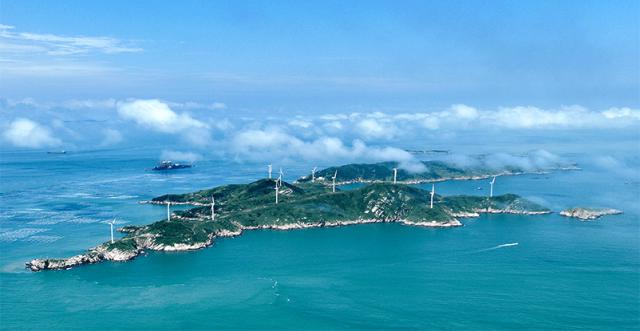
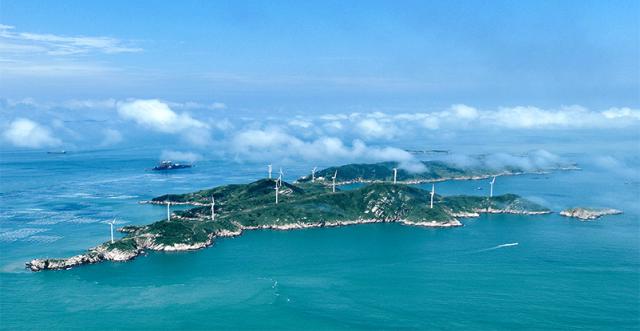
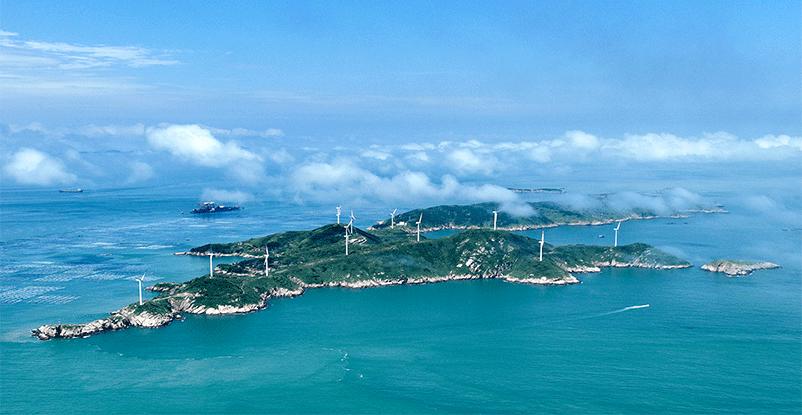
Wind turbines rotate on Lühua Island, Zhoushan, Zhejiang Province, June 8, 2024. Signaling China’s efforts in exploring the green ocean economy, the island is both a demonstration site for clean energy generation and a sightseeing spot for eco-friendly tourism (Photo by VCG)

As China leads the globe in harnessing green energy technologies, particularly wind and solar, a small group of researchers and business leaders are determined to develop a relatively untouched source of clean energy – the ocean. Despite its long coastline of around 32,000 kilometers, including 18,000 kilometers of mainland coastline and 14,000 kilometers of island coastlines, China is a latecomer to ocean energy generation, with a lack of national policy until recently. Without this boost, harnessing the waves and currents might just flounder.  

“Ocean energy power projects are advancing toward large-scale, commercialized development, with ongoing cost reductions and improved reliability,” Wang Ji, a researcher at the National Marine Technology Center told NewsChina. Ocean energy is generated from tidal currents and waves. Tidal current energy is the kinetic energy of water flow from tides, a form of ocean energy and a key renewable energy source.  

On Xiushan Island, Zhejiang Province, the LHD Marine Tidal Current Energy Power Station, developed by Hangzhou Lindong New Energy Technology, boasts China’s first megawatt-level tidal generator set and the world’s largest single-unit capacity. Installed in early 2016, its first unit started generating power and was connected to the national grid in August that year. Additional turbines and modules were installed in 2016 and 2018, bringing the single-platform installed capacity to 1.7 megawatts (MW).  

The LHD power station’s developer stated that by the end of July 2025, it had an installed capacity of 1.9 MW, generating over 2 million kilowatt-hours (kWh) annually, enough to power the island’s 200,000 households. With over eight years of continuous grid operation, it has supplied a cumulative 8.61 million kWh, leading globally in both single-unit scale and operational duration.  

According to statistics from the International Energy Agency (IEA), the global tidal and wave energy market was worth US$477.81 million in 2022 and is projected to hit around US$10 billion by 2031. At the IEA Ocean Energy System’s 50th Executive Committee meeting in Melbourne in September 2024, the Global Top 20 Marine Energy Highlights was released. The LHD power station, China’s only selected project, ranked first in tidal current energy and was recognized by the IEA as the world’s sole operational tidal current energy power station.  

In February 2025, the Ministry of Natural Resources and the National Development and Reform Commission of China jointly released the Guiding Opinions on Promoting the Large-Scale Utilization of Ocean Energy. It focuses on scaling up ocean energy use to foster new quality productive forces in the marine sector, with tidal current energy and wave energy as key development directions. 

Pioneering Attempts 
At Lindong New Energy’s headquarters in Binjiang District High-Tech Zone, Hangzhou, an exhibition hall collects real-time data from LHD generator sets. During a July visit, the reporter saw via surveillance cameras that the underwater turbine, stationary at low tide, started rotating and gradually accelerated as the afternoon tide rose.  

Construction of the second phase of the project began in 2018, followed by the 2022 launch of the 1.6 MW fourth-generation tidal current turbine called Fenjin (Endeavor) – a milestone as the world’s largest single-unit tidal current generator to successfully generate power and be connected to the grid.  

“On this single day, this unit’s peak power generation is 1,317 kW, with cumulative output of 3,804 kWh. Power output ties to tidal periodicity, one peak lasts about six hours, with two peaks daily,” Lin Dong, chair and chief engineer of Hangzhou Lindong New Energy, told NewsChina.  

The Endeavor power generation unit has so far accumulated over 5.5 million kWh of electricity. After LHD’s first-generation 1 MW unit was connected to the national grid in August 2016, following tech upgrades, the second and third generations followed in 2018. The third-generation unit remains in operation, generating over 1.3 million kWh cumulatively in more than six years.  

Shi Hongda, director of Ocean University of China’s Shandong Provincial Key Laboratory of Marine Engineering, told NewsChina that ocean energy includes tidal energy, tidal current energy, wave energy, ocean thermal energy conversion (OTEC) and salinity gradient energy.  

Tidal energy uses the rise and fall of the tides to power generators, tidal current energy generation is similar to wind power as it uses devices placed directly in the current to generate power, and wave energy uses devices that exploit the kinetic energy of the tides, using a buoy containing a generator loosely tethered to the seabed. Engineering practices are underway for these three, Shi said.  

In the case of the latter two processes, OTEC exploits temperature differences in ocean layers in tropical areas to power generators, and salinity gradient energy, also known as blue energy, uses the difference in salt levels between fresh and salt water. When salt and fresh water are mixed through osmosis, energy is released.  

Shi added that tidal power usually needs dams to use internal-external water level differences, and large bays must be enclosed to boost water flow to allow substantial output. “China has dense coastal populations. Though tidal energy has reliable principles and mature tech, its development doesn’t fit the national conditions,” he said. Enclosing coastlines for it would affect other marine projects in most areas, so tidal energy is not a key R&D focus in China.  

Unlike tidal energy, tidal current energy projects are usually sited in inter-island straits with high water flow and have less impact on offshore human activities. Professor Liu Hongwei at Zhejiang University’s School of Mechanical Engineering told NewsChina that tidal current energy is highly regular, and its turbines can draw on wind turbine technology as their use is similar.  

It is also less affected by offshore weather. Lin Dong noted that despite being hit by three typhoons in July, the LHD project’s daily power output fluctuated by less than 10 percent, and was not interrupted.  

In 2009, Lin Dong, who holds master’s degrees in business administration and energy development and management, founded LHD Technology in California with fluid mechanics expert Huang Changzheng and new materials expert Ding Xingzhe. The “LHD” abbreviation comes from their surnames’ first letters, and the company focused on tidal current energy research. Lin invested US$500,000 annually to explore tidal current energy power generation technical routes at first, conducting many experiments in an in-house circular water channel nicknamed the “swimming pool.”  

“Tidal current energy power generation was a cutting-edge field at the time, with no country having fully established a technical path,” Lin said. The UK installed SeaGen, the world’s first commercially grid-connected tidal current generator (1.2MW), in Strangford Lough, Northern Ireland, in 2008. It was decommissioned in 2016 and replaced by more efficient turbines.  

Shi Hongda noted that northern Europe has the world’s richest wave and tidal current energy due to differences between tides and favorable ocean currents. Though China has vast sea areas, it lacks resource advantages due to low energy flux density – a measure of energy passing through a unit area per unit time – which is limited as it lacks areas with strong tides. This means its tidal current energy utilization needs more advanced technology to generate power under low flow velocities. China’s exploitable tidal current energy has a theoretical average power of nearly 14 million kW, over half of which is in Zhejiang Province.  

In 2012, Lin led the LHD R&D team back to China and invested 200 million yuan (US$28m) to develop the Zhejiang LHD Marine Tidal Current Energy Power Station on Xiushan Island, the country’s first tidal current energy power station.  

Liu Hongwei’s team has researched tidal current energy power generation technology since 2004. In 2014, they built 60kW, 120kW and 650kW tidal current energy units on Zhoushan’s Zhairuo Mountain Marine Science and Technology Demonstration Island, and also constructed China’s first floating tidal current energy test power station. 
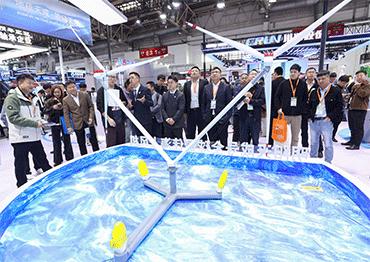
Visitors to the China Wind Power Expo and Conference (Beijing) view a model of the Mengyang Tiancheng, the world’s largest monolithic floating wind power platform, October 20, 2025 (Photo by VCG)

Economic Price 
“China has made breakthroughs in key marine energy technologies and now has the resources and technical foundation for large-scale tidal current and wave energy development. Its demonstration projects are still small, with relatively high power generation costs and tough challenges in continuous operation and maintenance,” Wang Ji said. He believes the key to marine energy breakthroughs lies in scaling up long-term stable-operation power stations.  

Data from the National Energy Administration shows China’s 2024 wind power generation hit 991.6 billion kWh, accounting for nearly 10 percent of overall electricity consumption. Shi Hongda noted that during the 15th Five-Year Plan (2026-2030), the primary goal of marine energy R&D is to boost capacity. He added that wind power grew rapidly once it reached the megawatt scale, so marine energy should aim for over 1 MW per installed unit.  

For tidal current energy, costs mainly come from offshore engineering. Liu Hongwei noted that tidal current energy unit hardware costs are not high – similar to wind turbine costs – and with sufficient capacity, costs can be kept below 10,000 yuan (US$1,404) per kilowatt. The real expense lies in building and maintaining offshore piles to support floating structures, as well as floating platforms, plus future deep-sea power transmission costs, which is an industry-wide obstacle. The stability, reliability and low costs of offshore infrastructure are key to tidal current energy industrialization.  

Wang believes China’s marine energy is now in the critical stage of advancing toward large-scale, industrialized development. Urgent breakthroughs are needed for key core technologies, along with improved equipment reliability and economy, and greater efforts to optimize technology design and upgrades.  

Grid connection for marine energy-generated electricity is more complex. Shi Hongda noted it requires negotiating with the power sector, and projects must meet the grid’s requirements for power, voltage, frequency and volatility. “Marine energy electricity prices are currently less competitive than wind and solar power,” he said.  

Lin Dong told the reporter that tidal current energy’s levelized cost of energy (A measure of the average net present cost of electricity generation for a generator over its lifetime) has dropped from 106 yuan/kWh (US$14.9, first generation) to 8.45 yuan/kWh (US$1.19, third generation) and further to 1.1 yuan/ kWh (US$0.15, fourth generation). It is expected to reach 0.3 yuan/kWh (US$0.04) by the seventh generation, lower than thermal power, which will lay the groundwork for large-scale projects to provide affordable ocean clean energy. LHD’s temporary electricity price is 2.58 yuan/kWh (US$0.36). 

Seeking a Way Out 
Liu Hongwei’s team’s tidal current energy station is running and generating electricity. But as a test facility, it does not benefit from a government-set electricity price, and operation and maintenance costs limit the units’ long-term operation.  

Liu Hongwei believes national support is vital to enable rapid commercialization of marine energy. “With appropriate electricity prices, existing test power stations can become grid-connected demonstration ones, letting technologies compete on a level playing field for sound development,” he said.  

The government has set a 2030 goal for marine energy: 400,000 kW of installed capacity, multiple island multi-energy complementary power systems, large-scale marine energy demonstration projects, and enterprises with strong R&D capabilities and global competitiveness for large-scale industry development.  

“We’re the only ones capable of long-term grid-connected power generation right now,” Lin Dong said, noting that no preferential policies were made specifically for their project. According to government tax rules, renewable energy projects must pay value-added tax on the electricity they sell. Thermal power is taxed at 13 percent, solar and wind pay a 6.5 percent rate after adjustments, and small hydropower is 3 percent. Since marine energy is not covered by preferential policies, it is taxed at the 13 percent thermal power rate. “This is a new field, and everything’s just starting,” Lin said.  

Shi Hongda believes marine energy development is closely tied to national policies. Europe’s early carbon trading and subsidy policies boosted renewable energy, but China currently has no dedicated subsidies for marine energy, so developers are exploring other solutions. Interviewees told NewsChina that domestic marine energy development needs lower costs, and Shi has proposed cooperative development of sites as an alternative path.  

Domestic offshore wind power has grown rapidly in recent years, and since 2022, its projects have been excluded from central financial subsidies, making cooperative site development of wind and wave energy a key opportunity for marine energy. Shi said that for floating wind turbines, wave energy devices can absorb impact on the turbines and boost safety, and that energy can be used for power generation, achieving a win-win situation.  

Liu Hongwei’s team is also researching deep-sea integrated energy development. He noted a key current trend is joint marine energy development with industries like fisheries and hydrogen production. There are already collaborations between wind power generators and fisheries, and wind power-based hydrogen production. Liu hopes tidal current energy can integrate with these industries too, to supply electricity to islands and produce fresh water and hydrogen.  

Shi Hongda has maintained contact and global cooperation with Scotland’s European Marine Energy Centre (EMEC) for over a decade. He and his team are now building a Marine Energy Offshore Comprehensive Test Site in the sea area of Zhaitang Island near Qingdao. “We hope it will become the China Marine Energy Center (CMEC) soon,” he said, adding that large-scale domestic marine energy development will be visible in the next five to 10 years.  

The National Marine Technology Center, where Wang Ji works, has built four test sites in Weihai, Shandong Province, Zhoushan, Zhejiang Province, Zhuhai, Guangdong Province and Sanya, Hainan Province, forming national-level offshore test grounds covering both shallow and deep seas.  

Lin said his company plans to build a 100 MW tidal current energy power plant, around five kilometers from the existing LHD station, with an estimated annual generation of 250 million kWh. “All the preliminary work is done, and we can start construction as soon as the electricity pricing policy is released,” he said.  

Lin also has ambitions for the Kuroshio Current, a fast, large-volume warm current in the northwestern Pacific also known as the Black Stream due to surface color differences. “This is the ‘oil’ at our doorstep, and it will be our next main battlefield,” he said.

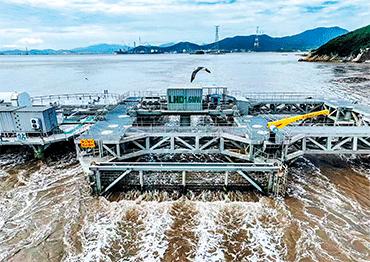
The Fenjin (Endeavour), the fourth-generation LHD Marine Tidal Current Energy Power Station and China’s first megawatt-level tidal energy generator, is launched on February 24, 2022, Xiushan Island, Daishan County, Zhejiang Province (Courtesy of the interviewee)

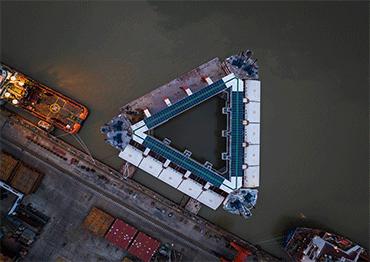
Pictured is the Nankun, China’s first self-developed megawatt-level floating wave energy generation device, Guangzhou, Guangdong Province, May 26, 2023 (Photo by VCG)

Print