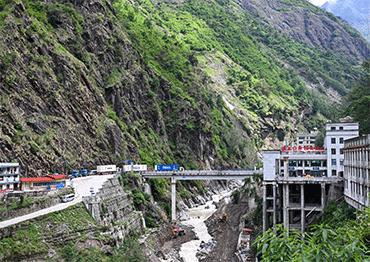
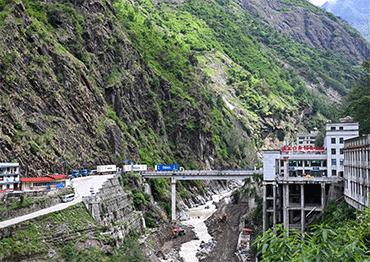
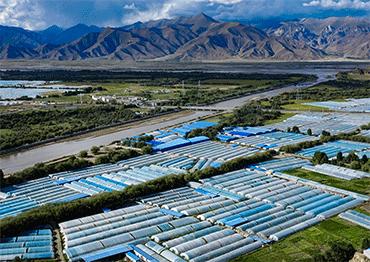
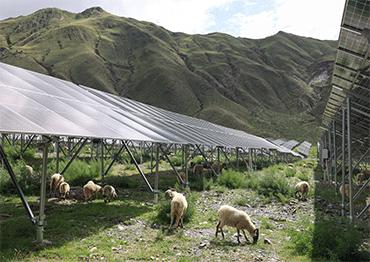
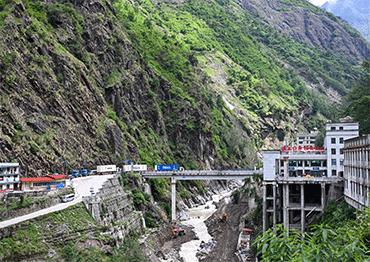
Nestled in the steep gorges on the southern slopes of the Himalayas, Zhangmu Port sits on the Boqu River, the natural boundary between China and Nepal.
As a key point along the China-Nepal Highway, Zhangmu Port is only 120 kilometers from Kathmandu, Nepal’s capital. Its advantageous location has made it an important border trade center in Xizang, earning it the nickname “Little Hong Kong of the Snowy Plateau.” This small town of just over 3,000 residents sees about 1,400 people come and go daily. Goods from across China meet those from Nepal and India here, creating a lively cross-border market.
Beyond its prosperity, Zhangmu looks like a “city in the sky” to Zhao Zhibin, a deputy captain at Zhangmu’s Nyalam Border Inspection Station. Buildings rise in tiers along winding mountain roads, stretching from the Friendship Bridge at an altitude of 1,700 meters up to the mountainside at 2,400 meters. Each morning, as mist rises, the entire town flickers like a mirage suspended mid-air.
Yet before the peaceful liberation of Xizang in 1950, this thriving port presented a starkly different picture. At that time, Zhangmu had only about 20 households. Locals made their living carrying goods on their backs for merchants year-round. They tied the goods tightly with a rope, fastened the load onto their backs, looped the rope over their heads for support and walked barefoot. The narrow, treacherous 30-kilometer trail from Zhangmu to Nyalam County was so dangerous that porters often collapsed and died on the way, earning it the grim nickname “the road to hell.”
“My grandmother was a porter back then,” said Gesang, a local youth standing on the China-Nepal Friendship Bridge. “She told me it took two days to make the trip. Now, thanks to the China-Nepal Highway, it takes just one hour by car to reach Nyalam.”
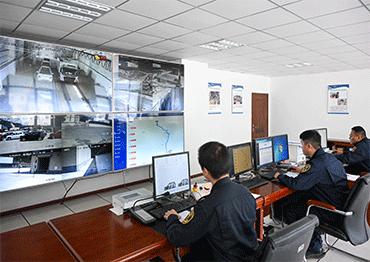
The 2015 earthquake dealt a devastating blow to the port. According to Zhao Zhibin, landslides blocked roads, buildings were destroyed, and port operations came to a complete stop. After eight years of reconstruction, Zhangmu Port fully resumed two-way personnel clearance on September 1, 2023. A newly built flood-control embankment now stands like a fortress guarding the valley, while an intelligent customs clearance system has accelerated inspections and cargo release, breathing new life into the revitalized port.
Goods from across China, like small home appliances from Guangzhou, Guangdong Province, footwear from Hebei Province, textiles from Yiwu, Zhejiang Province and new energy vehicles from Shandong Province, flow steadily through Zhangmu Port into South Asian markets. According to Nyalam Customs, from January to September 2025, the port handled 315,000 inbound and outbound travelers, with a daily peak of 2,737 people, and processed 66,000 metric tons of cross-border cargo valued at 2.12 billion yuan (US$299m).
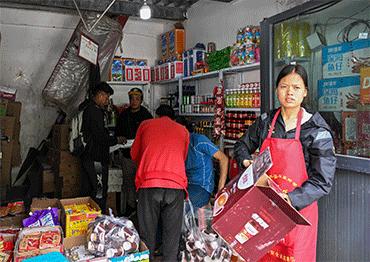
Along the narrow mountain road from the port to Zhangmu town, shops selling Chinese goods line both sides, forming a vibrant free trade market. Tamang works in one of those Chinese shops. People like Tamang move among the stalls carrying bundles of clothing, daily necessities, snacks and beverages on their heads and shoulders.
Inside one of these shops, Tamang deftly arranges Chinese products on the shelves, from instant noodles and egg-yolk snack cakes to sausages. She told reporters that daily sales range from 1,000-2,000 yuan (US$141-282).
She earns 900 yuan (US$127) a month now, after getting a raise from 800 yuan (US$113) recently. Her income has greatly improved her family’s livelihood. She also takes advantage of the convenient customs clearance to bring Chinese products to Nepal. “Many Chinese goods are very popular in Nepal,” she said.
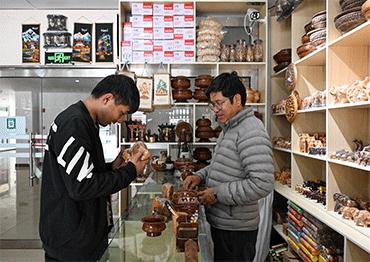
About 200 meters from the port, a new cross-border trade zone for residents along the border is under construction. This modern facility will offer a more standardized and convenient venue for traders from both sides.
At 6 pm, Tamang set off for Nepal with Chinese goods she purchased that day. The setting sun cast a golden glow over the China-Nepal Friendship Bridge as dozens of Nepalese border residents walked alongside her after a day’s work.
 Old Version